
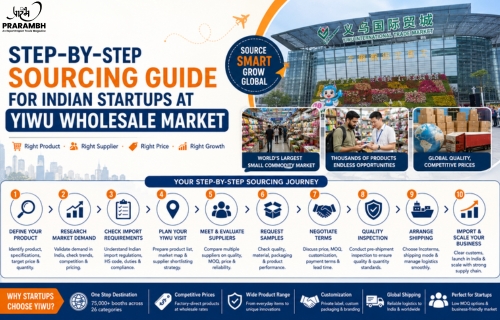
Yiwu International Trade Market
For Indian startups looking to source products internationally, the Yiwu Wholesale Market in China can be an important destination to explore. Located in Yiwu, Zhejiang Province, the market is known for its enormous variety of small commodities and wholesale products.
Entrepreneurs, wholesalers, retailers, e-commerce sellers, distributors, and importers visit Yiwu Market China to explore products, compare suppliers, negotiate prices, evaluate samples, and develop sourcing relationships.
However, successful product sourcing from China involves much more than finding a low-priced product.
Indian startups need to consider product demand, supplier verification, minimum order quantity (MOQ), samples, quality control, import regulations, landed costs, payment terms, logistics, and documentation.
This Yiwu sourcing guide for Indian startups explains the process step by step.


Why Should Indian Startups Explore Yiwu Wholesale Market?
The Yiwu International Trade Market is particularly relevant to startups because buyers can explore a large number of product categories and suppliers within one sourcing ecosystem.
Depending on the product category and supplier, buyers may find opportunities involving:
- Fashion accessories
- Home and kitchen products
- Gifts
- Toys
- Stationery
- Artificial flowers
- Beauty accessories
- Festival products
- Hardware
- Bags
- Packaging products
- Decorative products
- Small electronics accessories
- General merchandise
For startups that have not finalized a product, visiting a major China wholesale market can also help with product discovery and market research.
Step 1: Research the Indian Market Before Visiting Yiwu
A common sourcing mistake is traveling to China before deciding what the business actually needs.
Before visiting Yiwu Wholesale Market, conduct market research in India.
Analyze:
Customer Demand
What products are customers actively searching for?
Competition
Who already sells the product in India, and at what price?
Target Selling Price
Determine the realistic retail or wholesale price in your market.
Expected Margin
Estimate how much margin remains after purchasing, shipping, customs, taxes, packaging, marketing, and other costs.
Target Customer
Are you sourcing for retailers, distributors, e-commerce customers, corporate buyers, or consumers?
Good sourcing starts with a market requirement, not simply an attractive product.
Step 2: Select the Right Products to Source from China
Once demand is understood, shortlist products that fit your business model.
For an Indian startup, a good sourcing opportunity should ideally have a reasonable combination of:
Demand + Margin + Manageable MOQ + Compliance + Reliable Supply
Do not evaluate products based only on their Chinese wholesale price.
A product that costs less at the factory may become expensive after transportation, customs duties, taxes, certification, inspection, packaging, and domestic logistics are included.
Step 3: Calculate Your Target Landed Cost
Landed cost is one of the most important concepts when planning to import from China to India.
A simplified calculation may include:
Product Cost + China Local Charges + Freight + Insurance + Customs/Taxes + Clearance + Compliance Costs + Indian Transportation + Other Applicable Charges
For example, imagine that a product appears highly profitable based only on its Yiwu purchase price.
After adding freight and other import-related expenses, the actual margin may be significantly lower.
Therefore, determine your approximate maximum landed cost before negotiating with suppliers.
Step 4: Plan Your Yiwu Market Visit by Product Category
Yiwu is extremely large.
Walking through the market without a sourcing plan can waste considerable time.
Before your visit, prepare a sourcing sheet containing:
| Requirement | Details to Prepare |
|---|---|
| Product | Exact product/category |
| Quantity | Estimated initial order |
| Target Price | Preferred purchase range |
| MOQ | Maximum acceptable MOQ |
| Material | Required specifications |
| Quality | Expected standard |
| Packaging | Standard/custom |
| Branding | OEM/private label requirement |
| Destination | India |
| Timeline | Required delivery period |
Group similar products together so that you can compare relevant suppliers efficiently.
Step 5: Shortlist Multiple Yiwu Suppliers
Never depend immediately on the first supplier offering an attractive price.
For each important product, compare multiple Yiwu suppliers.
Record:
- Supplier name
- Booth/location
- Contact person
- Product specification
- Quoted price
- MOQ
- Sample availability
- Packaging
- Customization options
- Production lead time
- Payment terms
- Export experience
A structured supplier-comparison sheet can prevent confusion after visiting dozens of booths.
Step 6: Ask Every China Supplier the Right Questions
Price should be only one part of your supplier evaluation.
When discussing China product sourcing, ask questions such as:
What is your MOQ?
MOQ can significantly affect a startup’s initial investment.
Are you a manufacturer or trading company?
Understand who is actually supplying the goods.
Can you provide samples?
Samples are important for evaluating the product before a larger order.
What customization is available?
Ask about logos, colors, materials, dimensions, packaging, labels, and private branding.
What is your production lead time?
This matters for inventory planning.
What are your payment terms?
Confirm payment stages and accepted methods.
Which countries do you export to?
Relevant export experience can be useful when evaluating a supplier.
What documents or certifications are available?
Requirements vary significantly by product and destination.
Step 7: Understand MOQ Before Negotiating
Minimum Order Quantity (MOQ) is especially important for Indian startups.
Large orders may provide better unit prices but can create inventory risk.
Instead of asking only:
“What is your best price?”
Discuss:
- MOQ at different price levels
- Trial-order quantities
- Mixed designs or colors
- Mixed SKU options
- Packaging quantities
- Repeat-order pricing
For a new business, controlling inventory risk may be more valuable than achieving the absolute lowest unit price.
Step 8: Request and Evaluate Product Samples
Never assume that a display sample automatically represents the quality of your future bulk order.
Where appropriate, request samples before confirming production.
Evaluate factors such as:
- Material
- Dimensions
- Weight
- Color
- Finish
- Functionality
- Durability
- Packaging
- Branding
- Product consistency
If your product has technical or regulatory requirements, appropriate testing may also be necessary.
Step 9: Verify Suppliers Before Placing Large Orders
Supplier verification is an important part of sourcing from China.
Depending on the order value and product, verification can involve checking:
- Business registration
- Company information
- Manufacturing capabilities
- Factory location
- Product experience
- Quality systems
- Export history
- Relevant certifications
- References where appropriate
For larger or strategically important orders, a factory visit or independent verification may be worthwhile.
The goal is to determine whether the supplier can reliably deliver what was promised.
Step 10: Check Indian Import Rules Before Confirming the Product
This step should not be left until the goods are ready to ship.
Different products can have different import requirements in India.
Depending on the product, you may need to investigate matters such as:
- IEC requirements
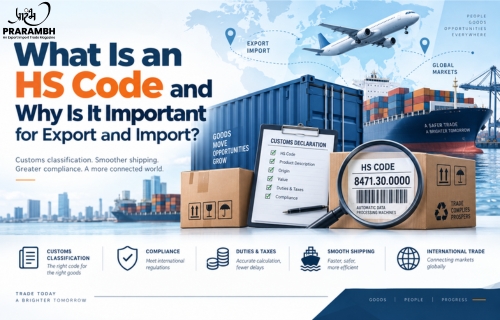
- HS classification
- Customs duties
- GST
- BIS requirements
- Legal Metrology requirements
- Product labeling
- Packaging requirements
- Sector-specific approvals
- Other applicable import regulations
Requirements vary by product, so businesses should verify the current rules with relevant Indian authorities and qualified customs/compliance professionals before ordering.
Step 11: Negotiate More Than the Product Price
Good negotiation at Yiwu Market China should consider the entire transaction.
You may negotiate:
- Unit price
- MOQ
- Sample charges
- Packaging
- Printing
- Branding
- Accessories
- Production time
- Payment terms
- Replacement policy
- Inspection arrangements
For example, a slightly higher-priced supplier offering better quality, lower MOQ, stronger packaging, and more dependable production may provide greater overall value.
Step 12: Get Every Important Specification in Writing
Verbal discussions are not enough for an international order.
Document agreed specifications clearly.
Include details such as:
- Product name/model
- Material
- Size
- Color
- Quantity
- Unit price
- Packaging
- Logo placement
- Labeling
- Quality requirements
- Delivery timeline
- Payment terms
- Shipping terms
- Other agreed requirements
For customized products, approved artwork and samples should be clearly identified.
Step 13: Understand OEM and Private Label Opportunities
Many Indian startups want more than generic wholesale products.
They want to build their own brands.
Depending on the supplier and product category, OEM and private label sourcing from China may allow businesses to customize:
- Brand logo
- Packaging
- Colors
- Product specifications
- Labels
- Inserts
- Cartons
Before choosing private labeling, calculate whether the additional MOQ and packaging costs make commercial sense.
Step 14: Conduct Quality Inspection Before Shipment
Quality control should happen before products leave China whenever appropriate.
Depending on the order, inspection may check:
- Quantity
- Product specifications
- Dimensions
- Color
- Workmanship
- Functionality
- Packaging
- Labeling
- Carton condition
- Other agreed criteria
Inspection does not eliminate every possible problem, but it can help identify issues before the goods travel internationally.
Step 15: Choose the Right Shipping Method from China to India
The appropriate shipping method depends on the product, volume, urgency, cost, and destination.
Air Freight
Generally faster but often more expensive.
It may suit:
- Smaller shipments
- Higher-value goods
- Urgent inventory
Sea Freight
Often more economical for larger commercial shipments but generally slower.
It may suit:
- Bulk orders
- Heavy products
- Larger volumes
- Less time-sensitive inventory
Your freight forwarder can help compare appropriate options for a particular shipment.
Step 16: Prepare Import Documentation Carefully
International trade depends heavily on accurate documentation.
Documents may include, depending on the shipment:
- Commercial invoice
- Packing list
- Bill of lading or airway bill
- Certificate of origin where applicable
- Insurance documents
- Product-specific certificates
- Customs-related documents
- Other required paperwork
Documentation requirements vary by product and shipment.
Incorrect or incomplete documents can contribute to customs delays and additional costs.
Step 17: Start Small, Test the Indian Market, Then Scale
For many startups, the smartest strategy is not to place the largest possible first order.
Consider:
Source → Test → Sell → Analyze → Improve → Reorder → Scale
A smaller initial commercial order can help you understand:
- Actual customer demand
- Selling price
- Customer feedback
- Return rates
- Packaging performance
- Product quality
- Marketing costs
- Inventory turnover
Once the product demonstrates sustainable demand, larger orders may become easier to justify.
Common Yiwu Sourcing Mistakes Indian Startups Should Avoid
Indian buyers should be particularly careful about several common mistakes:
- Buying products only because they are cheap
- Selecting the first supplier
- Failing to calculate landed cost
- Ignoring Indian compliance requirements
- Ordering without samples
- Failing to document specifications
- Paying without appropriate due diligence
- Skipping quality inspection
- Over-ordering during the first purchase
- Failing to plan freight and customs
- Choosing products without Indian market research
Successful Yiwu sourcing for Indian startups is fundamentally about reducing avoidable risks.
Yiwu Market vs Online China Sourcing
Both approaches have advantages.
Online Sourcing
Can be useful for initial supplier discovery, communication, product research, and remote comparison.
Visiting Yiwu Wholesale Market
A physical visit can allow buyers to:
- See products directly
- Compare suppliers quickly
- Examine samples
- Discuss customization
- Negotiate face-to-face
- Discover products they did not know existed
- Understand the sourcing ecosystem
For entrepreneurs exploring multiple product categories, visiting a wholesale market can provide valuable market intelligence beyond a single supplier conversation.
How Indian Startups Can Build Long-Term Relationships with China Suppliers
Successful sourcing should not end with one purchase order.
Reliable suppliers can become important business partners.
Build stronger relationships by:
- Communicating specifications clearly
- Paying according to agreed terms
- Providing structured feedback
- Forecasting future demand
- Discussing problems professionally
- Reviewing quality after each shipment
- Planning repeat orders in advance
As order history develops, businesses may be able to negotiate improved commercial terms.
Final Yiwu Sourcing Checklist for Indian Startups
Before placing your order, confirm:
✓ Product demand validated in India
✓ Target landed cost calculated
✓ Multiple suppliers compared
✓ Supplier verification completed
✓ Sample approved
✓ MOQ confirmed
✓ Specifications documented
✓ Indian compliance checked
✓ Packaging and branding approved
✓ Payment terms agreed
✓ Quality inspection planned
✓ Freight method selected
✓ Import documentation reviewed
✓ Customs costs estimated
✓ Backup supplier identified where practical
Conclusion: Source Smart at Yiwu Wholesale Market
The Yiwu Wholesale Market for Indian startups can provide significant opportunities for entrepreneurs looking for new products, wholesale suppliers, private-label possibilities, and international sourcing experience.
But successful sourcing is not simply about traveling to China and finding the cheapest supplier.
Indian startups should combine market research, supplier comparison, product sampling, compliance checks, landed-cost calculations, quality control, negotiation, and logistics planning.
The most effective strategy is simple:
Research in India → Explore Yiwu → Compare Suppliers → Verify → Sample → Negotiate → Inspect → Import → Test → Scale.
With a structured approach, product sourcing from Yiwu, China can become part of a sustainable import and growth strategy for Indian startups.
Frequently Asked Questions
1. What is Yiwu Wholesale Market?
Yiwu Wholesale Market refers primarily to the massive wholesale trading ecosystem centered around Yiwu International Trade Market in Zhejiang, China, known particularly for small commodities and general merchandise.
2. Is Yiwu Market suitable for Indian startups?
It can be suitable for startups seeking wholesale products, supplier discovery, product variety, smaller-commodity sourcing, customization and private-label opportunities.
3. What products can Indian businesses source from Yiwu?
Common categories include gifts, toys, stationery, accessories, household products, beauty accessories, decorations, packaging products, hardware and general merchandise.
4. How can I find reliable Yiwu suppliers?
Compare multiple suppliers, verify business information, inspect samples, document specifications and consider appropriate third-party verification or inspection before major orders.
5. Can Indian startups import directly from China?
Indian businesses can import eligible products subject to applicable registration, customs, taxation, labeling, product-specific regulatory and other legal requirements.
6. What should I check before importing from Yiwu to India?
Check Indian demand, supplier credentials, product quality, HS classification, regulatory requirements, landed cost, MOQ, payment terms, shipping and quality-control arrangements.
7. Can I get private-label products from Yiwu suppliers?
Many suppliers may offer branding, custom packaging and other customization, depending on the product, quantity and supplier capabilities.
8. How should startups calculate sourcing costs?
Calculate the full landed cost rather than only the supplier price. Consider product, packaging, freight, insurance, applicable duties/taxes, clearance and local transportation.
9. Should I visit Yiwu or source products online?
Both approaches can work. Visiting Yiwu can be particularly useful when you want to physically compare many products and suppliers, negotiate face to face and discover new product opportunities.
10. What is the best strategy for first-time Yiwu buyers?
Start with market research, shortlist specific products, compare multiple suppliers, inspect samples, verify compliance and landed costs, begin with manageable quantities, and scale after validating demand.