
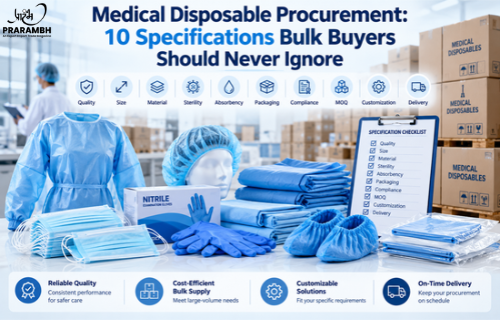
Buying medical disposable products in bulk is an important responsibility for hospitals, clinics, laboratories, healthcare distributors, and medical supply importers. Products such as disposable gowns, aprons, coveralls, surgical apparel, and other protective clothing must meet the requirements of their intended use.
For bulk buyers, selecting a supplier based only on price can lead to problems such as inconsistent product quality, incorrect sizing, and inadequate protection, damaged packaging, and delayed deliveries.
What should bulk buyers check before purchasing medical disposables? They should evaluate material quality, product specifications, protective performance, sizing, regulatory compliance, packaging, shelf life, and supplier reliability before placing an order.
This guide explains the 10 essential specifications to check when procuring disposable medical products in bulk, helping healthcare buyers make informed purchasing decisions.
- Material Composition and Quality
The material used in a medical disposable directly affects its comfort, strength, durability, and suitability for a particular application.
Disposable medical apparel may be manufactured using non-woven materials such as spunbond polypropylene, SMS (spunbond-meltblown-spunbond), or other specialized materials, depending on the product design and intended protection.
What should buyers check?
- Material type and composition
- Fabric weight or GSM, where applicable
- Tensile strength and resistance to tearing
- Softness, breathability, and wearer comfort
- Consistency of material across production batches
For example, a general-purpose patient gown and a fluid-resistant surgical gown may require different material properties. Buyers should specify the intended application rather than assuming that all non-woven gowns offer the same protection.
- Protective Performance and Intended Use
Not every disposable medical garment provides the same level of protection. Buyers must identify the risks the product is designed to address.
For example, healthcare workers handling routine patient care may require different protective apparel from personnel involved in procedures with potential exposure to blood or other body fluids.
What should buyers check?
- Intended use and user group
- Resistance to fluids, where required
- Barrier performance and relevant test reports
- Seam strength and garment coverage
- Compliance with applicable product standards
Ask the manufacturer for supporting test reports and clear product specifications. Claims such as “water-resistant,” “fluid-resistant,” and “waterproof” should not be treated as interchangeable.
The selected product must be suitable for the risk level and the healthcare facility’s infection-prevention procedures.
- Correct Size, Fit, and Design
Incorrect sizing can affect comfort, movement, coverage, and the practical use of medical disposable apparel.
Bulk buyers should consider the needs of different users and the requirements of each department.
What should buyers check?
- Available sizes, such as S, M, L, XL, and XXL
- Garment length and width
- Sleeve length and cuff design
- Neck closure, waist ties, or fastening system
- Coverage during normal working movements
For example, a hospital purchasing disposable coveralls for a range of staff members should confirm the size chart and evaluate sample garments before approving a large order.
Do not rely on size labels alone. Request actual garment measurements and clarify acceptable tolerances with the supplier.
- Sterility Requirements
One of the most important procurement decisions is whether the product needs to be sterile or non-sterile.
Many disposable medical products are supplied non-sterile for applications where sterility is not required. Products intended for sterile procedures must meet the relevant sterility requirements and be supplied in suitable packaging.
What should buyers check?
- Whether the product is sterile or non-sterile
- The sterilization method, if applicable
- Evidence of a validated sterilization process
- Sterility assurance documentation, where applicable
- Integrity of the sterile packaging
Never assume that a product is sterile simply because it is individually packed or labeled for hospital use. Verify the claim and supporting documentation.
- Regulatory Compliance and Quality Certifications
Medical disposable products may be subject to different regulatory requirements depending on the product category and destination country.
Bulk buyers should confirm which licences, registrations, standards, and conformity documents apply to the particular product.
What should buyers check?
- Applicable medical device or product regulations
- Required manufacturer or importer licences
- Relevant quality management certifications
- Product conformity documents and test reports
- Validity and scope of certificates
ISO 13485 is a quality management system standard specifically associated with medical devices. However, an ISO 13485 certificate alone does not establish that every product is approved for every market or application.
Similarly, standards such as ISO 10993 may be relevant to biological evaluation when appropriate to the product and its intended contact with the body.
For imports and exports, buyers should verify the requirements of the destination market and avoid relying solely on a supplier’s general claim of being “internationally certified.”
- Packaging Quality and Product Labeling
Packaging protects medical disposables during handling, storage, and transportation. It can also provide important information for healthcare staff and procurement teams.
For sterile products, packaging must maintain the required sterile barrier until use, subject to the product’s validated shelf life and storage conditions.
What should buyers check?
- Individual or bulk packaging, as required
- Packaging strength and seal integrity
- Product name and model or reference number
- Manufacturer and batch or lot identification
- Sterile or non-sterile status, where applicable
- Manufacturing date, expiry date, and storage instructions, where required
For sterile medical devices, ISO 11607 provides requirements for packaging systems intended to maintain sterility after terminal sterilization. Buyers should confirm that the packaging and labeling are appropriate for the specific product.
- Shelf Life and Storage Conditions
Medical disposables may deteriorate if stored incorrectly or used beyond their established shelf life.
This is especially important for bulk buyers who may hold inventory for several months before distributing or using it.
What should buyers check?
- Manufacturer-declared shelf life
- Remaining shelf life at delivery
- Recommended storage temperature and humidity, if specified
- Protection from sunlight, dust, moisture, and physical damage
- Stock rotation and expiry-management procedures
For example, a distributor receiving a large shipment should confirm that sufficient shelf life remains for onward sale and use.
Use a first-expiry, first-out (FEFO) inventory system wherever appropriate. For sterile products, damaged, wet, opened, or compromised packaging must be assessed according to the manufacturer’s instructions and applicable procedures before use.
- Product Consistency and Quality Control
A sample may meet expectations, but the delivered bulk order must also match the approved specifications.
Variations in fabric, stitching, dimensions, packaging, or product performance can cause difficulties for hospitals and distributors.
What should buyers check?
- Pre-production or approval samples
- Defined acceptance criteria
- Inspection and testing records
- Batch traceability
- Procedures for handling defects and complaints
Where possible, document the agreed specifications in the purchase order or supply agreement. Establish what happens if products fail inspection, including replacement, corrective action, or rejection arrangements.
- Order Quantity, Lead Time, and Supply Capacity
Bulk procurement requires reliable supply planning. A low-priced product offers little value if the supplier cannot deliver the required quantity on time.
What should buyers check?
- Minimum order quantity (MOQ)
- Production capacity and lead time
- Delivery schedule and shipment terms
- Availability of repeat orders
- Carton dimensions, weight, and packing quantity
- Contingency plans for supply delays
For importers and distributors, confirm whether the supplier can maintain consistent specifications across repeat orders. If a product is customised, agree on the design, material, packaging, and approval process before production begins.
- Total Cost, Supplier Reliability, and After-Sales Support
The lowest unit price does not always represent the lowest procurement cost.
Bulk buyers should consider product performance, delivery, packaging, inspection, wastage, and the cost of handling quality-related issues.
What should buyers check?
- Price per unit and total order value
- Freight, insurance, duties, and other applicable charges
- Sample and inspection costs
- Payment terms and delivery commitments
- Complaint handling and replacement policy
- Supplier experience and references, where available
Request a detailed quotation that clearly defines the product specifications, quantity, packaging, delivery terms, and payment conditions.
Before placing a large order with a new supplier, consider evaluating samples, checking documentation, and starting with a manageable order where practical.
Conclusion
Successful medical disposable procurement requires more than comparing prices. Bulk buyers must verify material composition, protective performance, sizing, sterility, regulatory compliance, packaging, shelf life, quality consistency, supply capacity, and total cost.
A clear procurement checklist helps hospitals, healthcare distributors, importers, and clinics reduce purchasing risks and select products suited to their intended applications.
The best medical disposable supplier is one that delivers consistent product quality, appropriate documentation, reliable supply, and transparent communication—not simply the lowest quotation.
By defining specifications before ordering and evaluating suppliers carefully, bulk buyers can make more confident procurement decisions and support the day-to-day needs of healthcare facilities.
Frequently Asked Questions (FAQs)
- What specifications should bulk buyers check when purchasing medical disposables?
Buyers should check material composition, protective performance, sizing, sterility, regulatory compliance, packaging, shelf life, quality control, supply capacity, and total cost.
- Why is material quality important in disposable medical apparel?
Material quality affects garment strength, comfort, breathability, and protective performance. The material must be suitable for the intended application and the risks involved.
- What is the difference between sterile and non-sterile medical disposables?
Sterile products have undergone an appropriate validated sterilization process and meet applicable sterility requirements. Non-sterile products have not been supplied as sterile. The correct choice depends on the intended use and relevant clinical procedures.
- Is ISO 13485 certification sufficient when buying medical disposables?
No. ISO 13485 relates to a medical device quality management system. Buyers should also verify product-specific requirements, applicable regulations, relevant test reports, and any required market authorizations.
- What documents should buyers request from a medical disposable supplier?
Depending on the product and market, relevant documents may include product specifications, test reports, quality certificates, applicable licenses or registrations, batch details, sterility documentation, and shelf-life information.