

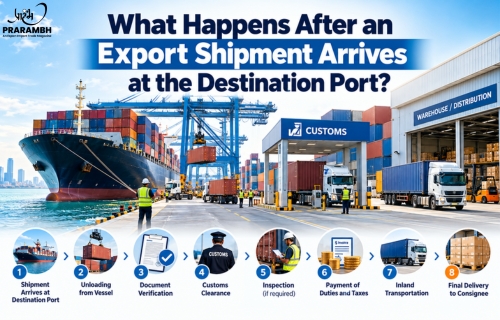
Once your export shipment leaves India, the journey is not over. When the goods reach the destination country, they must pass through several procedures before the overseas buyer can receive them.
From unloading and customs clearance to payment of import duties and final delivery, understanding this process helps Indian exporters avoid delays, unexpected charges and misunderstandings with buyers.
Let us understand what happens when an export shipment reaches a foreign port.
Step 1: The Ship or Aircraft Arrives at the Destination
When the vessel or aircraft reaches the destination, the carrier reports the arrival of the cargo to the relevant authorities. For sea shipments, containers are unloaded and moved to the designated port terminal or container yard.
The cargo may remain at the port or an authorized storage facility until the necessary formalities are completed.
Example: An Indian exporter ships 1,000 kg of turmeric powder to a buyer in Germany. When the vessel arrives, the container is unloaded and the cargo is placed in the designated terminal area.
Step 2: The Shipping Line or Carrier Submits Cargo Information
The shipping line or airline provides cargo information to the destination country’s authorities. This helps customs identify the goods arriving in the country.
The carrier also provides transport documents, such as the Bill of Lading for sea freight or Air Waybill for air freight.
The buyer or their customs broker uses these documents, along with the commercial invoice and packing list, to arrange clearance.
Step 3: The Importer or Customs Broker Files the Import Declaration
The overseas buyer, usually through a licensed customs broker where required, submits the import declaration to the destination country’s customs authority.
Depending on the country, this declaration may be called a Bill of Entry or have another name.
Common documents include:
- Commercial Invoice
- Packing List
- Bill of Lading or Air Waybill
- Certificate of Origin, where required
- Import licence, product certificates or permits, where applicable
The exact documents depend on the product and destination country’s regulations.
Step 4: Customs Checks the Shipment
Customs authorities examine the import declaration and supporting documents to determine whether the shipment can be imported legally.
They may verify:
- Product description and HS code
- Declared value and quantity
- Country of origin
- Applicable import duties and taxes
- Required licences, certificates and product compliance
Customs may also order a physical inspection or request laboratory testing if necessary.
Example: If the shipment contains turmeric powder, authorities may check whether it meets the destination country’s food safety and import requirements. If documents are missing or the declaration is incorrect, clearance may be delayed.
Step 5: Import Duties and Taxes Are Assessed
Once the relevant details are checked, customs determines the applicable import duties and taxes.
The amount depends on factors such as the product’s HS classification, customs value, country of origin, applicable trade agreements and local tax rules.
The importer or the responsible party arranges payment as required.
Example: An Indian exporter sends handicrafts to a buyer in France. The import duty and taxes applicable to the goods will depend on their classification, customs value, origin and relevant EU rules.
Remember, the importer may be able to claim a preferential tariff if the goods meet the applicable rules of origin and the required proof is provided.
Step 6: Customs Releases the Shipment
If the documents are in order, applicable duties and taxes are settled, and all regulatory requirements are met, customs issues the required release or clearance authorization.
However, customs release does not always mean the cargo can immediately leave the port. The buyer may still need to complete terminal, shipping-line or other release formalities.
If customs identifies discrepancies or requires further checks, the shipment may remain on hold.
Step 7: Port and Shipping-Line Charges Are Settled
Before collecting the cargo, the responsible party may need to pay applicable charges, such as:
- Terminal handling charges
- Port storage charges
- Shipping-line delivery or documentation charges
- Demurrage or detention charges, where applicable
Demurrage may arise when a container stays at the terminal beyond the permitted free time. Detention may arise when a shipping-line container is kept outside the terminal beyond the allowed period.
These charges can increase the total landed cost of the goods.
Step 8: The Goods Are Delivered to the Buyer
After customs clearance and completion of the necessary release procedures, the cargo can be collected and transported to the buyer’s warehouse, factory or distribution centre.
For sea freight, this may involve a truck or rail movement from the port. For air freight, the goods are collected from the cargo terminal and delivered to the buyer.
The buyer should check the goods for quantity, damage and any discrepancies upon receipt.
Who Is Responsible for These Steps?
The division of responsibilities depends on the agreed Incoterm, the sales contract and local requirements.
- Exporter: Provides accurate shipping documents and fulfils the exporter’s agreed obligations.
- Importer: Usually arranges import clearance, duties and taxes when responsible under the contract.
- Customs broker: Handles declarations and clearance formalities on behalf of the importer or exporter, as applicable.
- Shipping line or airline: Provides transport information and coordinates cargo handling and delivery procedures.
- Customs authority: Enforces import laws, verifies declarations, assesses duties and taxes, and authorizes release.
- Port terminal or cargo handler: Stores and handles cargo until it is released for collection.
Incoterms such as FOB, CIF, DAP and DDP affect the division of costs, responsibilities and risks. They should be agreed upon before shipment.
Conclusion
When an export shipment reaches a foreign port, it must pass through arrival formalities, import documentation, customs checks, applicable duty and tax payments, cargo release and final delivery.
For Indian exporters, the key is to prepare accurate documents, understand the buyer’s import requirements and agree clearly on responsibilities under the sales contract and Incoterm.
Remember: A shipment is not fully delivered simply because it has reached the destination port. It must complete the required clearance and delivery procedures before the buyer can receive it.
Frequently Asked Questions (FAQs)
- What happens when an export shipment reaches a foreign port?
The cargo is unloaded, arrival information is recorded, import documents are submitted, customs checks the shipment, applicable duties and taxes are paid, and the goods are released for delivery.
- Who clears the shipment at the destination port?
The overseas importer usually arranges import customs clearance, either directly where permitted or through a customs broker. The agreed Incoterm and local laws determine the precise responsibilities.
- What documents are required for destination port customs clearance?
Common documents include the commercial invoice, packing list, Bill of Lading or Air Waybill, and import declaration. A Certificate of Origin, permits, inspection certificates or other documents may also be required.
- Can customs stop or inspect an export shipment after it reaches the destination?
Yes. Customs may inspect the goods, request additional documents, verify the declared value or classification, or refer the goods for regulatory checks.
- Who pays import duty and taxes in the destination country?
The responsible party depends on the agreed Incoterm and sales contract. Under many common arrangements, the buyer handles import clearance and duties, while under DDP the seller generally assumes these obligations, subject to the contract and local law.
- What are demurrage and detention charges?
Demurrage generally relates to a container remaining at the terminal beyond its free time. Detention generally relates to keeping a shipping-line container outside the terminal beyond the permitted period. Definitions and charging rules vary by carrier and contract.
- How long does destination port customs clearance take?
It varies by country, port congestion, cargo type, documentation accuracy, inspection requirements and regulatory approvals. Straightforward shipments may clear relatively quickly, while shipments requiring testing or additional documents can take longer.
- What happens if the buyer does not clear the shipment on time?
The cargo may accumulate storage, demurrage or other charges. If it remains unclaimed for a prolonged period, local rules may allow further action, including sale, re-export or disposal. The exporter should contact the buyer and shipping or logistics provider promptly if a delay occurs.