
For Indian exporters, the Indian diaspora can be an important source of international demand. Indians living in countries such as the USA, UK, Canada, Australia, UAE, Singapore and New Zealand often look for products from India that are familiar, culturally important, or difficult to find in the same variety and quality in their country of residence.
This creates opportunities not only for large exporters but also for Indian SMEs, manufacturers, merchant exporters, food processors, handicraft businesses and small brands.
Demand can range from Indian food and spices to traditional clothing, religious products, handicrafts, beauty products and household items.
Recent cross-border commerce observations also show strong India-origin demand in diaspora markets such as the USA, UAE and Canada, particularly for apparel, beauty products and Indian groceries.
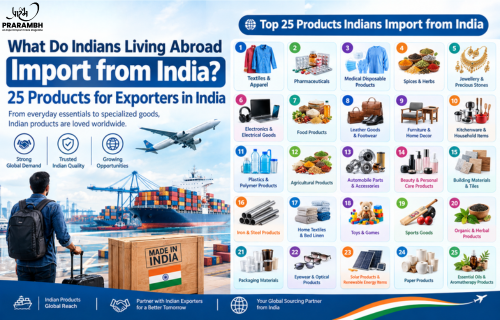
25 Top Products Indians Abroad May Import from India
The following list identifies product categories that can be explored by Indian exporters targeting diaspora consumers, Indian grocery stores, ethnic retailers, distributors and e-commerce sellers.
| No. | Product | HS Code* | Why Indians Abroad May Buy It |
|---|---|---|---|
| 1 | Basmati Rice | 10063020 | Indian households, restaurants and grocery stores |
| 2 | Other Rice | 10063090 | Regular household consumption and ethnic food businesses |
| 3 | Turmeric | 091030 | Cooking, traditional food preparations and wellness products |
| 4 | Cumin Seeds | 090931 | Indian cooking and spice blends |
| 5 | Chilli / Chilli Powder | 0904 | Indian cuisine and food processing |
| 6 | Coriander Seeds / Powder | 0909 | Everyday Indian cooking |
| 7 | Garam Masala & Spice Blends | 91091 | Convenience and traditional Indian cooking |
| 8 | Pickles | 200190 | Strong cultural and household demand |
| 9 | Papad | 190590 | Indian meals and festive occasions |
| 10 | Namkeen / Indian Savoury Snacks | 190590 / 210690 | Snacks and festive consumption |
| 11 | Indian Sweets & Traditional Confectionery | 170490 / 210690 | Festivals, celebrations and gifting |
| 12 | Ready-to-Eat Indian Foods | 210690 | Convenience for Indian households abroad |
| 13 | Millet-Based Foods | 1904 / 1104 | Traditional grains and health-oriented food products |
| 14 | Indian Tea | 902 | Household consumption and gifting |
| 15 | Instant Coffee / Indian Coffee Products | 901 | Indian-origin beverage demand |
| 16 | Indian Ethnic Wear | 6204 / 6205 / 6206 | Festivals, weddings and cultural events |
| 17 | Sarees | 6211 | Weddings, festivals and traditional occasions |
| 18 | Kurtis / Kurta-Pajamas | 6204 / 6205 | Everyday ethnic and festive clothing |
| 19 | Indian Home Textiles | 6302 / 6304 | Indian-style home décor and household use |
| 20 | Handicrafts & Decorative Products | 4420 / 6913 / 7419 | Home décor, gifting and cultural products |
| 21 | Incense Sticks / Agarbatti | 330741 | Religious and household use |
| 22 | Puja & Religious Products | 4421 / 6913 / 8306 | Festivals, temples and home पूजा |
| 23 | Henna / Mehendi Products | 140490 / 330499 | Weddings, festivals and beauty use |
| 24 | Ayurvedic / Herbal Personal-Care Products | 330499 / 3004** | Traditional wellness and personal care |
| 25 | Indian Beauty & Hair-Care Products | 3305 / 3304 | Familiar Indian formulations and beauty routines |
*HS classification can vary according to the exact product, formulation, material, ingredients, processing and packaging. Exporters should verify the applicable 8-digit ITC(HS) code before shipping.
**Medicinal and Ayurvedic products require particular care because classification and regulatory requirements can depend on whether the product is a medicine, supplement, cosmetic or other preparation.
This means an Indian exporter can build a B2B export business around diaspora demand instead of trying to sell one parcel at a time directly to consumers.
Which Countries Should Indian Exporters Explore?
Countries with sizeable Indian-origin communities can be natural starting points for research.
Potential markets include:
- USA UK
- Canada Australia
- UAE Saudi Arabia
- Singapore Malaysia
- New Zealand Trinidad & Tobago
- South Africa Oman
- Qatar Germany
- France Mauritius
- Fiji Guyana
- One must check which countries have a large Indian Diaspora. A country can be small but Indian population can be large for example in Trinidad & Tobago.
Why Diaspora Markets Can Be Interesting for Indian SMEs
Large global markets can sometimes be difficult for a new exporter because competition is high.
Diaspora-oriented exports offer another route: start with a clearly identifiable customer community and then expand beyond it.
For example:
Indian spices → Indian grocery stores → South Asian stores → mainstream supermarkets
This can allow an exporter to build a focused market-entry strategy instead of trying to sell to an entire country immediately.
Conclusion
Indians living abroad can create international demand for many products originating from India—from rice, spices and snacks to sarees, handicrafts, agarbatti, beauty products and traditional household goods.
For an Indian SME, the opportunity is can be in knowing and understanding which Indian products have diaspora demand, can be exported compliantly, and can generate a sustainable margin after reaching the destination market?”
Exporter must actively do buyer research, HS-code classification, destination-country regulations, competition, freight costs and landed-price analysis.
FAQs
1. Can a small Indian exporter sell directly to Indians abroad?
Yes. An exporter can explore B2C channels such as e-commerce and diaspora-focused platforms, but B2B channels such as Indian grocery stores, distributors, importers and ethnic retailers can also be important.
2. How do I find the HS code for an Indian export product?
The HS/ITC(HS) code depends on the exact product and its characteristics. Exporters can use the ICEGATE Trade Guide and India’s official trade databases to verify classification before exporting.
3. Is selling to the Indian diaspora enough to make a product a good export opportunity?
Not necessarily. Diaspora demand is a useful starting point, but exporters should also check destination-country regulations, import duties, competition, freight costs, shelf life, buyer availability and final landed price before entering the market.
-
Can exporting a small quantity be profitable?
Yes. Small-quantity exports can be profitable when the product has good margins, manageable shipping costs, repeat demand, and buyers willing to pay for smaller orders. They can be particularly suitable for SMEs testing a new market before moving to larger shipments.