
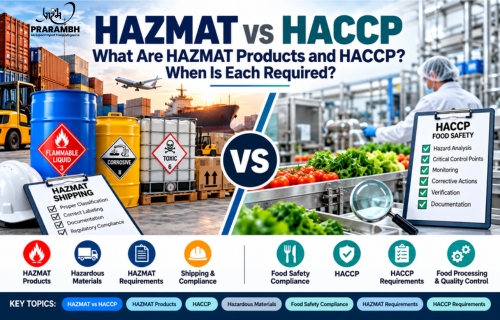
HAZMAT vs HACCP
When entering international trade, exporters often come across terms such as HAZMAT and HACCP. Although both are related to safety, they address different types of risks.
What Are HAZMAT Products?
HAZMAT means Hazardous Materials. These are substances or products that can pose a risk to people, property, transport or the environment because of their physical or chemical properties.
Examples include:
- Flammable chemicals
- Corrosive substances
- Toxic chemicals
- Certain gases
- Some paints, solvents and cleaning chemicals
- Certain batteries
When exporting HAZMAT products, the exporter may need to follow specific dangerous goods classification, packaging, labelling, documentation and transportation requirements.
Simple Example
Suppose an Indian company exports a flammable chemical to Germany. The product may be classified as dangerous goods for transport. The exporter must follow the applicable dangerous-goods requirements for the chosen mode of transportation.
What Is HACCP?
HACCP stands for Hazard Analysis and Critical Control Points. It is a systematic food-safety management approach used to identify, evaluate and control hazards that could make food unsafe.
HACCP focuses on hazards such as:
- Biological hazards
- Chemical hazards
- Physical hazards
Simple Example
A company manufacturing fruit juice may identify risks such as microbial contamination. It can establish critical control points, such as controlling a heat-treatment process, to reduce the food-safety risk.
HAZMAT vs HACCP: What Is the Difference?
| Point | HAZMAT | HACCP |
| Meaning | Hazardous Materials | Hazard Analysis and Critical Control Points |
| Main focus | Safe handling and transport of hazardous materials | Food safety |
| Commonly relevant to | Chemicals, gases, batteries and other dangerous goods | Food manufacturing and processing |
| Main concern | Risks during handling, storage and transportation | Preventing food-safety hazards |
| Example | Flammable chemical | Contamination in a food-processing line |
Important: HAZMAT and HACCP are not the same thing. HAZMAT describes hazardous materials/products, while HACCP is a food-safety hazard-control system.
When Is HAZMAT Required?
HAZMAT or dangerous-goods requirements become relevant when a product is classified as hazardous under the applicable regulations, particularly during transport, packaging, labelling and documentation.
The exact requirements depend on the product classification and mode of transport, such as air, sea, road or rail.
When Is HACCP Required?
HACCP requirements depend on the food product, destination country, customer requirements and applicable regulations. Food businesses may use HACCP as part of their food-safety management system, and some markets or buyers may require HACCP-based controls or certification.
Therefore, exporters should check the requirements of the destination country and buyer before shipping.
Conclusion
HAZMAT and HACCP address different safety concerns. HAZMAT relates primarily to hazardous materials and their safe handling and transportation, while HACCP is a preventive system for controlling food-safety hazards.
For exporters, understanding the difference is important because the wrong classification, documentation or compliance approach can create delays and additional costs.
FAQs
- Is HAZMAT the same as HACCP?
No. HAZMAT refers to hazardous materials, while HACCP is a food-safety hazard-control system.
- Is HACCP only for food products?
HACCP is primarily associated with food safety and food-related operations.
- Are all chemicals HAZMAT?
No. A chemical is not automatically classified as hazardous material for transport. Its classification depends on its properties and the applicable regulations.
- Does every food exporter need HACCP certification?
Not necessarily. Requirements depend on the product, destination market, applicable regulations and buyer requirements.
- Can a product be both HAZMAT and related to HACCP?
Yes, in some situations. For example, a food-processing operation may use a chemical that is classified as hazardous material. HAZMAT requirements and HACCP controls would address different aspects of the situation.