
Choosing the right mode of transportation is an important decision in export business. It affects your shipping cost, delivery time, product safety and customer satisfaction.
Indian exporters can send goods through sea, air, road, railways, international courier services and India Post. However, every mode is suitable for a different shipment size, destination, product and delivery requirement.
This guide explains the major modes of transportation for exporting from India and helps new exporters select the most suitable option.
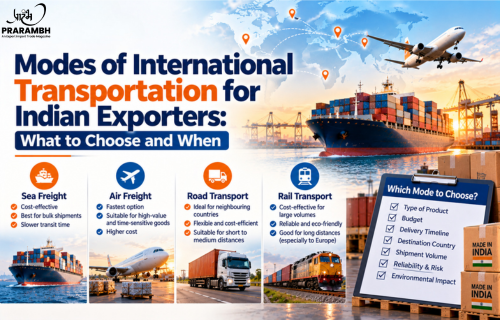
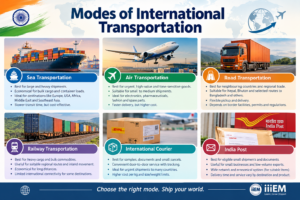
- Sea Transportation – Best for Bulk and Heavy Shipments
Sea freight is one of the most commonly used modes for international trade. Goods are transported in containers or as bulk cargo through seaports.
Best suited for:
- Large and heavy shipments of rice, spices, textiles, engineering goods and industrial raw materials.
- Full Container Load (FCL) and Less than Container Load (LCL) shipments.
- Destinations such as Europe, the USA, Africa, the Middle East, Southeast Asia and other regions connected by shipping routes.
When should you use it?
Choose sea freight when the shipment is large, the product is not urgently required and transportation cost per unit is important.
- Air Transportation – Best for Urgent and High-Value Goods
Air freight transports goods through international airports. It is generally faster than sea freight, although the total delivery time depends on handling, customs clearance and flight availability.
Best suited for:
- High-value electronics, precision components, pharmaceuticals where permitted, fashion products and urgent spare parts.
- Small to medium commercial shipments.
- Destinations with suitable air cargo connections, including Europe, North America, the Middle East and Asia.
When should you use it?
Choose air freight when delivery speed, product value or the cost of a delay justifies the higher transportation expense.
- Road Transportation – Best for Neighbouring Countries
Road transport moves goods by trucks across international land borders. Its usefulness depends on India’s land-border trade routes, border facilities, transit permissions and the regulations of the countries involved.
Best suited for:
- Shipments to eligible neighbouring markets, especially Nepal and Bhutan, subject to applicable routes and procedures.
- Selected cargo movements to Bangladesh and other accessible neighbouring destinations, depending on the permitted route and current border arrangements.
- Regional trade where door-to-door truck movement is practical.
- Railway Transportation – Best for Heavy Cargo on Suitable Routes
Rail freight is useful for moving heavy or large quantities of goods over land. International rail transport from India depends on available rail connections, transit arrangements and bilateral or regional trade procedures.
Best suited for:
- Bulk commodities, minerals, agricultural commodities, industrial inputs and other heavy cargo.
- Suitable regional routes where rail connectivity and operating arrangements are available.
- Domestic movement of export cargo from inland locations to ports or cargo terminals.
- International Courier – Best for Samples and Small Parcels
International courier services offer convenient, often door-to-door shipping with tracking. They are widely used for export samples, documents and small consignments.
Best suited for:
- Product samples, documents, prototypes, small spare parts and low-volume shipments.
- Urgent parcels for buyers in the USA, UK, Europe, the Middle East, Asia and other serviceable destinations.
- Small shipments where convenience matters more than the lowest freight cost.
- India Post – A Useful Option for Eligible Small Shipments
India Post offers international postal services for eligible destinations and categories of goods. The availability of merchandise, tracking, insurance and delivery options depends on the service selected and the destination country’s rules.
Best suited for:
- Eligible documents, samples, small parcels and lightweight consignments.
- Small businesses testing overseas demand or sending low-volume shipments.
- Destinations covered by the selected international postal service.
- Important Tips Before Booking Export Transportation
- Know your cargo: Confirm the product description, HS code, quantity, gross weight, dimensions and packaging.
- Compare complete quotations: Ask for pickup, export handling, customs clearance, freight, destination charges and final delivery costs.
- Check export documentation: Depending on the shipment, you may need a commercial invoice, packing list, shipping bill or postal export declaration, transport document and product-specific certificates.
- Check product restrictions: Batteries, chemicals, food, medicines, liquids and other regulated products may require special approval or may not be accepted by some carriers.
- Understand Incoterms®: Agree with your buyer on who arranges and pays for transportation, insurance and import clearance.
- Insure appropriately: Check carrier liability and consider cargo insurance based on the product and shipment risk.
- Check delivery time realistically: Allow for customs clearance, transshipment, weekends, holidays and possible delays.
- Start with a small trial shipment: For a new buyer, a properly documented sample or pilot order can help you understand the process before shipping a larger consignment.
Conclusion
Selecting the right mode of transportation is not simply about finding the cheapest freight rate. It is about balancing cost, speed, shipment size, destination, product requirements and reliability.
For new Indian exporters, international courier and India Post may be useful for eligible small shipments, air freight for urgent cargo, sea freight for bulk and containerized exports, and road or rail for suitable regional or inland routes.
The best mode is the one that delivers your goods safely, legally and on time at a commercially viable total cost. Always compare quotations and verify current carrier services and export requirements before dispatch.
Frequently Asked Questions (FAQs)
- Which is the cheapest mode of transportation for exporting from India?
Sea freight is often economical for large and heavy shipments. For small parcels, India Post or an international courier may be suitable, depending on the destination, weight, dimensions and service selected.
- Should a new exporter choose air freight or sea freight?
Choose air freight when speed is important and the higher cost is justified. Choose sea freight when the cargo is large, delivery is less urgent and the total cost per unit is a priority.
- Can I export product samples through international courier?
Yes, eligible samples can often be sent through international courier services. Check carrier acceptance rules, customs declarations, destination requirements and any applicable export formalities.
- Can I export commercial goods through India Post?
India Post may accept eligible merchandise shipments to covered destinations. Confirm the service, permitted goods, weight limits, customs declaration process and current commercial-export requirements before sending the parcel.
- Is road transport available for exports from India to every neighboring country?
No. Road transportation depends on accessible routes, border-crossing arrangements, customs procedures, permits and the rules applicable to the countries involved.
Disclaimer: Transportation services, routes, rates, weight limits and customs procedures can change. Verify current requirements with the relevant carrier, freight forwarder, customs broker and authorities before dispatch.