
What Is a Certificate of Origin?
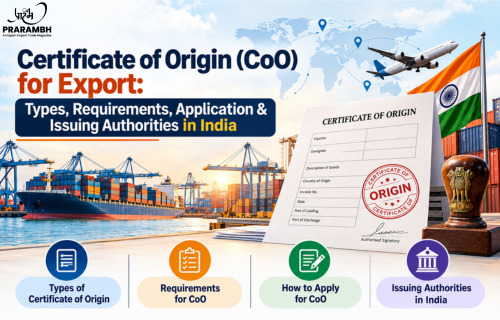
A Certificate of Origin (CoO) is an official document that confirms the country in which an exported product originates.
In simple words, it tells the importing country:
“This product was made or produced in this country.”
A CoO may be required by the buyer, importing country’s customs authority, or under a Free Trade Agreement (FTA)/Preferential Trade Agreement (PTA).
What Are the Types of Certificate of Origin?
There are two broad types:
| Type | Purpose |
| Preferential CoO | Used when the exporter wants the importer to claim a reduced or zero customs duty under an FTA/PTA or other preferential arrangement. |
| Non-Preferential CoO | Certifies the origin of goods but generally does not provide a preferential duty benefit. |
- Preferential Certificate of Origin
This is used when your product qualifies for benefits under a trade agreement.
Example:
An Indian exporter ships an eligible product to a country with which India has a relevant trade agreement. If the product meets the agreement’s rules of origin, the importer may use the Preferential CoO to claim a lower customs duty.
- Non-Preferential Certificate of Origin
This confirms that the goods originate from India but does not normally provide an FTA duty concession.
For example, an overseas buyer may ask an Indian exporter for a Non-Preferential CoO as part of its import documentation.
When Is a Certificate of Origin Required?
A CoO may be required when:
- The importing country requires proof of origin.
- The overseas buyer specifically asks for it.
- The shipment is covered by an FTA/PTA and preferential duty is being claimed.
- Customs or other authorities require origin verification.
- The product or transaction has specific origin-related requirements.
Important: A CoO is not automatically required for every export shipment. The requirement depends on the destination, product, trade agreement and buyer/import regulations.
Where Can an Indian Exporter Obtain a CoO?
Indian exporters can apply through the DGFT’s electronic Certificate of Origin platform (eCoO) for applicable preferential and non-preferential CoOs.
Depending on the type of CoO and applicable arrangement, the certificate may be issued or attested by the designated issuing authority, such as authorized Chambers of Commerce or other notified agencies, your respective Export Promotion Body or FIEO.
Before applying, check the current DGFT requirements and the specific issuing authority applicable to your shipment.
What Documents May Be Required?
The exact requirements vary, but an exporter may need:
- Commercial Invoice
- Packing List
- Shipping/export details
- Product description and HS Code
- Declaration of origin
- Purchase/manufacturing details, where applicable
- Supporting documents to establish rules of origin for preferential CoO
For preferential CoOs, additional evidence may be required to demonstrate that the product satisfies the relevant Rules of Origin.
Simple Example
An Indian company exports bicycle chains to a foreign buyer.
The buyer asks for a Certificate of Origin to establish that the goods are of Indian origin. The exporter applies through the applicable CoO process and obtains the appropriate certificate.
If the buyer is also claiming an FTA/PTA benefit, the exporter must additionally ensure that the bicycle chains satisfy the relevant preferential Rules of Origin.
Conclusion
A Certificate of Origin is an important export document that establishes the origin of goods. The two main categories are Preferential CoO and Non-Preferential CoO. Preferential CoOs can help eligible importers claim reduced customs duty under applicable trade agreements, while Non-Preferential CoOs primarily establish the country of origin.
Before exporting, always check the destination country’s requirements, buyer’s requirements and applicable trade agreement to determine which CoO is needed.
FAQs
- Is a Certificate of Origin mandatory for every export?
No. It depends on the destination country, product, buyer requirements and applicable trade agreement or regulations.
- What is the difference between Preferential and Non-Preferential CoO?
A Preferential CoO can support a claim for reduced or zero customs duty under an applicable trade agreement. A Non-Preferential CoO generally confirms origin without providing such preferential duty benefits.
- Where can I obtain a Certificate of Origin in India?
Indian exporters can use the DGFT eCoO system and the designated issuing authorities applicable to the particular type of CoO.
- Does a Certificate of Origin reduce customs duty?
Not by itself. A preferential CoO can support a reduced-duty claim only when the shipment qualifies under the applicable trade agreement and its Rules of Origin.
- Is a Certificate of Origin the same as a Country of Origin declaration?
Not necessarily. A CoO is a formal origin document issued or certified by an authorised authority, whereas an origin declaration may be a statement made by the exporter or producer under a particular trade arrangement.