
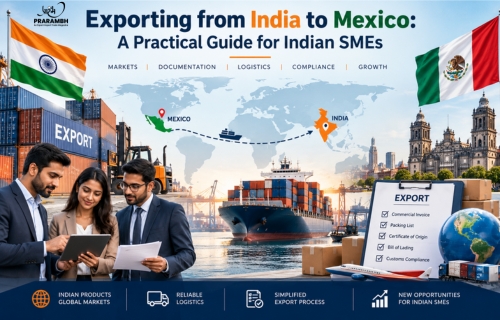
Exporting from India to Mexico
Mexico is emerging as an important market for Indian exporters looking to diversify beyond traditional destinations such as the United States, Europe and the Middle East.
For Indian SMEs, Mexico offers opportunities across engineering goods, auto components, chemicals, pharmaceuticals, textiles, food products, spices, machinery, electrical products and selected consumer goods.
India already has a substantial trade relationship with Mexico. India’s Ministry of Commerce reported merchandise exports to Mexico of US$5.75 billion in FY 2024–25, compared with US$5.32 billion in FY 2023–24.
But exporting to Mexico is not simply a matter of finding a buyer and shipping the product. Indian exporters must understand Mexican tariff classification, customs procedures, NOM standards, Spanish-language labeling, sanitary and phytosanitary requirements and product-specific regulations.
This guide explains how an Indian SME can approach the Mexican market.
What Products Can India Export to Mexico?
There is no single “best product” for Mexico. Product selection should be based on Mexican import demand, Indian supply capability, landed cost, competition, tariff rate and regulatory requirements.
For Indian SMEs, the following product groups offer areas for market research.
| Product Category | Examples of Indian Products | SME Opportunity |
| Engineering Goods | Industrial components, machinery parts, tools, equipment | High potential for B2B supply |
| Auto Components | Components, replacement parts, accessories | Strong manufacturing ecosystem |
| Electrical & Electronics | Motors, electrical equipment, components, telecom equipment | Suitable for technically capable suppliers |
| Chemicals | Organic chemicals, dyes, pigments, specialty chemicals | Attractive B2B segment, but compliance must be checked |
| Plastics & Polymers | Polymer products, plastic components, industrial materials | Suitable for industrial buyers |
| Textiles | Cotton yarn, fabrics, selected textile products | Established Indian manufacturing base |
| Spices & Food Ingredients | Spices, spice ingredients, selected processed foods | Opportunity with appropriate food compliance |
| Pharmaceuticals | Generic medicines, APIs and healthcare products | Large opportunity but highly regulated |
| Gems & Jewellery | Cut and polished diamonds, gemstones, jewellery | Established Indian capability |
| Machinery | Industrial machinery and components | B2B opportunity for specialised SMEs |
The reference article specifically identifies automobiles, engineering goods, electronics, chemicals, fertilizers, pharmaceuticals, metals, gems, jewellery, agricultural products and textiles among India’s major export sectors to Mexico.
India–Mexico Trade: An Opportunity for Diversification
India’s merchandise exports to Mexico reached approximately US$5.75 billion in FY 2024–25, while bilateral merchandise trade was approximately US$8.62 billion.
This demonstrates that Mexico is already an established destination for Indian products—not merely a theoretical emerging market.
At the same time, Mexico is a large import market overall. WTO data reports Mexico’s total imports at approximately US$663.6 billion in 2025, illustrating the scale of the market Indian exporters are entering.
The opportunity for Indian SMEs is therefore not simply “selling Indian products in Mexico.”
It is about identifying specific Mexican industries, importers and product niches where an Indian supplier can compete on quality, price, reliability and compliance.
Conclusion
Mexico offers Indian SMEs an important opportunity to diversify their export markets.
India already exports billions of dollars of merchandise to Mexico, with major sectors including engineering goods, automobiles and auto components, chemicals, pharmaceuticals, electronics, textiles, agricultural products, metals and gems and jewellery.
For a new exporter, however, success in Mexico requires more than identifying a product with demand.
The exporter must understand the Mexican tariff classification, import duty, NOM standards, labeling rules, sanitary and phytosanitary requirements, customs documentation and landed cost before making a commercial offer.
The most practical strategy for an Indian SME is:
Choose the right product → verify Mexican demand → check compliance → calculate landed cost → identify genuine buyers → start with a controlled shipment → build repeat business.
Mexico should therefore be viewed not simply as another export destination, but as a market that requires product-specific research and regulatory preparation.
For Indian SMEs willing to undertake this preparation, Mexico can become a valuable part of a diversified international export strategy.
Frequently Asked Questions (FAQs)
1. What products can India export to Mexico?
India exports automobiles, auto components, engineering goods, electronics, chemicals, pharmaceuticals, textiles, spices, agricultural products, gems and jewellery, machinery and other manufactured products to Mexico. The suitability of a product should be evaluated based on demand, tariff and Mexican regulations.
2. Is there an India–Mexico Free Trade Agreement?
India and Mexico do not currently have a general bilateral FTA providing preferential tariff treatment. Indian products therefore generally face Mexico’s applicable MFN tariff regime unless a specific preference or exemption applies.
3. What is Mexico’s import duty on Indian products?
There is no single import duty applicable to all Indian products. Mexico’s tariff varies according to the product’s Mexican TIGIE classification. The WTO reports Mexico’s 2026 simple-average MFN applied tariff at 11.1%, but individual products can have substantially different rates.
4. What is TIGIE in Mexico?
TIGIE is Mexico’s tariff classification system used for customs purposes. Indian exporters should establish the correct Mexican tariff classification before calculating duty or quoting a Mexican buyer.
5. What is NOM certification in Mexico?
NOM refers to Normas Oficiales Mexicanas, Mexico’s mandatory official standards/regulations for specified products. Depending on the product, NOM requirements can relate to safety, technical specifications, labeling, health or other requirements.
6. Can a small Indian business export to Mexico?
Yes. An Indian SME can explore Mexico as an export market. However, the exporter should first verify the product’s Mexican tariff classification, duty, compliance requirements, logistics cost and buyer requirements.
Disclaimer: Import duties, tariff classifications, NOM requirements, sanitary requirements, labeling rules and other Mexican regulations can change and are product-specific. Exporters should verify the applicable requirements with the Mexican importer/customs broker and relevant Mexican authorities before shipment.