
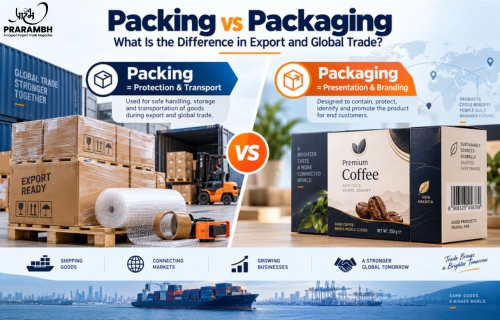
In export-import business, packing and packaging are often confused. Although both protect products, their purposes are different.
Packing mainly protects goods during transportation and handling, while packaging protects, identifies and presents the product.
What Is Packing?
Packing means preparing goods for safe storage, handling and transportation.
It protects products from:
- Breakage and impact
- Moisture and dust
- Vibration
- Pressure and rough handling
Common packing materials: cartons, wooden crates, pallets, stretch film, bubble wrap, foam and straps.
Example: Several product boxes may be placed inside a strong export carton and secured on a pallet.
What Is Packaging?
Packaging means enclosing and presenting a product for protection, identification, distribution and sale.
It may contain:
- Product and brand name
- Quantity or net weight
- Ingredients/specifications
- Batch or lot number
- Manufacturing or expiry details, where applicable
- Country of origin
- Usage instructions
- Barcode or QR code
Example: A printed box containing one ceramic mug is product packaging.
Packing vs Packaging: Key Difference
| Point | Packing | Packaging |
| Main purpose | Transportation and handling | Product protection and presentation |
| Main focus | Shipment | Product and customer |
| Materials | Cartons, crates, pallets, stretch film | Boxes, pouches, bottles, wrappers, labels |
| Branding | Usually limited | Often important |
| Information | Shipping details | Product and regulatory information |
Importance of Packing and Packaging in Global Trade?
| Packing | Packaging |
| Protects goods during transportation | Protects and presents the product |
| Reduces damage and product loss | Provides important product information |
| Makes goods easier to handle and store | Supports branding and customer convenience |
| Helps protect against impact, moisture and pressure | Helps meet applicable labelling requirements |
What Should Exporters Check?
Before shipping, exporters should check:
- Product: Is it fragile, liquid, perishable, heavy or hazardous?
- Transport: Will it travel by sea, air, road or multiple modes?
- Destination: Are there specific packaging, labelling or marking rules?
- Buyer: Does the buyer have specific carton, pallet or labelling requirements?
- Shipping Marks: Are carton number, weight, origin or handling symbols required?
Simple Export Example
An Indian exporter shipping ceramic mugs to Germany may use a printed box as packaging for each mug and strong cartons, protective material and pallets as packing for the shipment.
Packaging = Product-level protection and presentation
Packing = Shipment-level protection and transportation safety
Conclusion
Packing and packaging are both essential in export and global trade.
Packing focuses on protecting goods during transportation and handling, while packaging focuses on protecting, identifying and presenting the product.
Exporters should select both according to the product, transport method, buyer requirements and destination-country regulations.
FAQs
- What is the difference between packing and packaging?
Packing mainly protects goods during transportation and handling, while packaging protects and presents the product.
- Why is packing important in export?
It helps protect goods from breakage, moisture, impact, vibration and rough handling.
- What are common export packing materials?
Cartons, wooden crates, pallets, stretch film, bubble wrap, foam and straps are commonly used.
- Does packaging need to follow destination-country rules?
Yes. Depending on the product and country, specific labelling, safety and environmental requirements may apply.
- Can packing and packaging be used together?
Yes. Packaging protects and presents the product, while packing provides additional protection during storage, handling and transportation.