
International trade fairs are excellent opportunities for exporters to meet overseas buyers, distributors, importers and business representatives. They provide a platform to showcase products, understand international markets, build business relationships and explore new export opportunities.
However, meeting an international buyer at a trade fair does not automatically mean getting an export order. The real work begins after the meeting.
Many new exporters collect visiting cards, exchange product catalogues and discuss prices but fail to follow up properly. As a result, promising business opportunities may disappear.
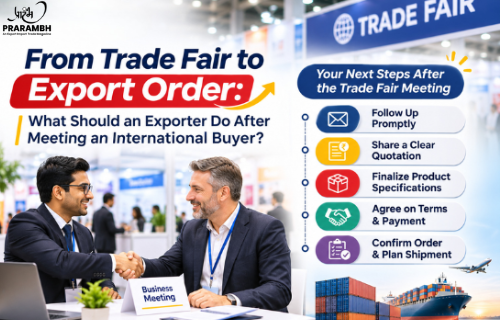
So, what should an exporter do after meeting an international buyer at a trade fair? How can you convert an initial discussion into a confirmed export order?
Here are 10 practical steps every new and experienced exporter should follow.
- Organize Buyer Information Immediately
Do not wait several days to organize the contacts collected at the trade fair.
Record important information about every buyer you meet.
Information to collect:
- Buyer’s name and company.
- Country and website.
- Email address and contact number.
- Products of interest.
- Estimated purchase quantity.
- Target price, if discussed.
- Special requirements or certifications.
SEO Insight: Maintaining an organized international buyer database helps exporters manage trade fair leads and improve export sales follow-ups.
- Send a Thank-You Email within 24–48 Hours
A professional follow-up email helps the buyer remember your company and the discussion.
Avoid sending a generic promotional message. Mention where you met and which products you discussed.
Example:
“Dear Mr. John,
It was a pleasure meeting you at the International Trade Fair in Dubai. We enjoyed discussing your requirements for Indian-origin Makhana.
As discussed, please find attached our company profile and product catalogue. We look forward to exploring a business association with your company.”
Keep the email short, professional and personalized.
- Research and Verify the International Buyer
Before spending time and money on samples or quotations, understand who you are dealing with.
Check:
- Company’s official website.
- Business registration details, where accessible.
- Import and distribution activities.
- Product portfolio.
- Business address and contact details.
- Trade references and available credit information.
For larger orders, consider professional buyer verification through commercial databases, credit reports or appropriate verification agencies.
- Understand the Buyer’s Actual Requirements
A buyer may show interest in your product but may not be ready to place an order.
Ask relevant questions to understand the requirement.
For example:
- What quantity do you normally purchase?
- Are you buying for distribution, manufacturing or retail?
- What product specifications do you require?
- Do you need private labeling or customized packaging?
- Which quality certifications are required?
- What is your preferred delivery timeline?
Understanding these details helps exporters prepare suitable quotations instead of sending prices without knowing the buyer’s expectations.
- Share the Right Product Catalogue and Specifications
Do not send hundreds of product pages if the buyer is interested in only two or three products.
Share relevant information such as:
- Product specifications.
- Product photographs.
- Available grades and varieties.
- Packaging details.
- Minimum Order Quantity (MOQ).
- HS Code, where appropriate.
- Applicable certifications and test reports.
For example, if a buyer is interested in Epsom Salt, share its grade, purity, packaging options, technical specifications and relevant MSDS/SDS documentation.
This creates a professional impression and helps the buyer evaluate your product.
- Send a Clear and Competitive Export Quotation
Once you understand the buyer’s requirements, prepare a formal export quotation.
Your quotation should mention:
- Product name and specifications.
- Quantity.
- Unit price and currency.
- Applicable Incoterms (FOB, CFR, CIF, etc.).
- Port of loading and destination.
- Packaging details.
- Payment terms.
- Delivery schedule.
- Quotation validity.
Example: If a buyer from Germany wants 5,000 kg of an Indian product, provide separate pricing under the agreed delivery terms, such as FOB Mundra or CIF Hamburg, where feasible.
A transparent quotation reduces confusion and helps buyers compare your offer with other suppliers.
- Offer Samples or a Trial Order
Some international buyers prefer to test a product before placing a bulk order.
Depending on the product, you can offer:
- Product samples.
- Trial quantities.
- Laboratory test reports.
- Product demonstrations.
- Sample packaging.
For example, an overseas buyer interested in Indian Moringa Leaf Powder may request samples to check color, taste, quality and laboratory parameters.
Before dispatching samples, agree on sample costs, courier charges, and documentation and delivery arrangements.
- Follow Up Without Being Too Pushy
One of the biggest mistakes exporters make is either not following up or sending repeated messages asking, “Any update?”
Instead, follow a structured communication schedule.
| Follow-up | Suggested action | |
| Day 1–2 | Thank-you email | |
| Day 4–5 | Share catalogue and specifications | |
| Day 7–10 | Ask for feedback | |
| Day 12–15 | Discuss samples or quotation | |
| Day 20–30 | Check purchase plans and next steps | |
These are suggested intervals, not fixed rules. Adjust them according to the buyer’s response and business cycle.
Use email, LinkedIn or WhatsApp professionally, depending on the communication preference established by the buyer.
- Negotiate Commercial Terms Carefully
When a buyer shows serious interest, commercial negotiations begin.
Discuss the following before accepting an order:
- Final price.
- Minimum order quantity.
- Payment terms and advance payment.
- Incoterms and freight responsibility.
- Delivery schedule.
- Product quality specifications.
- Inspection requirements.
- Packaging and labeling.
- Claims and dispute-handling arrangements.
For new buyers, exporters should carefully evaluate payment risks. Avoid agreeing to open-credit terms without proper verification and risk assessment.
- Convert the Discussion into a Confirmed Export Order
When the buyer agrees to the commercial terms, move towards formal order confirmation.
The usual process includes:
- Receive the buyer’s Purchase Order (PO), where applicable.
- Issue a Proforma Invoice (PI).
- Confirm payment arrangements.
- Finalize product specifications and packaging.
- Arrange production or procurement.
- Complete applicable export documentation.
- Coordinate shipment and dispatch.
Do not begin manufacturing or dispatching goods merely on the basis of a verbal discussion. Ensure that the order, payment and contractual requirements are properly confirmed.
Common Mistakes Exporters Should Avoid After a Trade Fair
Even a promising buyer meeting can fail because of poor follow-up.
Avoid these mistakes:
- Waiting too long to contact the buyer.
- Sending irrelevant catalogues and promotional messages.
- Quoting prices without understanding product specifications.
- Ignoring buyer verification.
- Offering unrealistic delivery timelines.
- Agreeing to risky payment terms.
- Failing to record meeting details.
- Following up excessively without adding value.
Conclusion: The Real Business Begins After the Trade Fair
An international trade fair is not just an opportunity to display products; it is an opportunity to develop long-term export relationships.
Collecting business cards is only the first step. Organizing buyer information, sending timely emails, verifying buyers, understanding requirements, sharing product details, preparing quotations and negotiating carefully are what help convert meetings into export orders.
For new exporters in India, the most important lesson is simple: Do not measure trade fair success by the number of visiting cards collected. Measure it by the quality of buyer relationships developed and the business opportunities converted into orders.
A systematic follow-up strategy can help you go from Trade Fair to Export Order and build a lasting relationship with the buyer.
Frequently Asked Questions (FAQs)
Q1. What should an exporter do after meeting an international buyer at a trade fair?
An exporter should organize buyer details, send a thank-you email, verify the company, understand product requirements, share specifications and prepare a suitable export quotation.
Q2. How soon should an exporter contact a buyer after a trade fair?
Ideally, send a personalized thank-you email within 24–48 hours while the meeting is still fresh in the buyer’s memory.
Q3. How can a new exporter convert trade fair leads into export orders?
By following up professionally, understanding buyer requirements, offering samples, providing competitive quotations and negotiating clear commercial terms.
Q4. Should exporters send free samples to international buyers?
Not necessarily. Sample policies depend on product value, buyer credibility and business potential. Exporters can charge for samples and courier costs where appropriate.
Q5. How can exporters verify an international buyer?
Check company registration, official website, business activities, trade history, references and financial information through reliable verification sources.
Q6. What should an export quotation include?
It should include product specifications, quantity, price, currency, Incoterms, delivery schedule, payment terms, packaging and quotation validity.
Q7. How many times should an exporter follow up with an overseas buyer?
There is no fixed number. A structured follow-up over several weeks is generally useful. However, communication should remain relevant and respectful of the buyer’s response.
Q8. What is the next step after receiving an international buyer’s order confirmation?
The exporter should verify the Purchase Order, issue a Proforma Invoice, confirm payment arrangements, finalize specifications and begin the agreed order-processing and shipment procedures.