
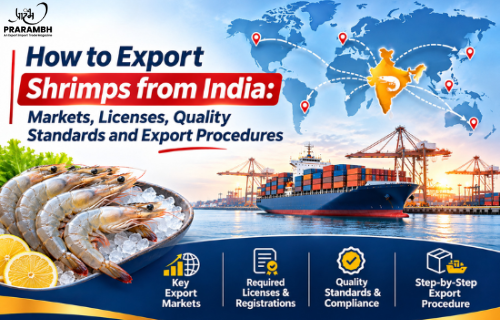
India is one of the important suppliers of seafood to international markets, and shrimp is among its most valuable seafood export products.
India is the world’s second-largest exporter of shrimp, after Ecuador. With frozen shrimp exports reaching approximately US$5.62 billion in FY 2025–26, India has established itself as a major supplier in the global seafood market.
With growing global demand for frozen and processed seafood, exporting shrimps from India offers opportunities for seafood manufacturers, processors, merchant exporters and businesses interested in international trade.
Shrimp exports require more than identifying an overseas buyer. Exporters must understand seafood quality standards, processing requirements, cold-chain management, export registrations, health certifications and destination-country regulations.
This guide explains how to export shrimps from India, the major international markets, mandatory registrations, documentation and important considerations for new seafood exporters.
- What Types of Shrimps Can India Export?
India exports different varieties of shrimp, mainly in frozen and processed forms.
Some commonly traded varieties include:
- Vannamei Shrimp (Whiteleg Shrimp): One of India’s major commercially farmed shrimp varieties. It is popular in international markets because of its availability, size options and versatility.
- Black Tiger Shrimp: Known for its larger size, distinctive appearance and firm texture. It is preferred in premium seafood markets.
- Freshwater Shrimp: Certain freshwater prawn varieties are also traded internationally.
- Sea-caught Shrimp: Shrimp harvested from marine waters, subject to applicable fishing and export regulations.
Popular export forms include:
- Head-on Shell-on (HOSO)
- Headless Shell-on (HLSO)
- Peeled and Deveined (P&D)
- Peeled Tail-on
- Cooked and Frozen Shrimp
- Raw Frozen Shrimp
The exporter should select the product form according to the buyer’s requirements and the importing country’s food safety standards.
- What Is the HS Code for Shrimp Exports from India?
Shrimp generally falls under Chapter 03 of the Harmonized System (HS), covering fish, crustaceans, mollusks and other aquatic invertebrates.
| Product category | HS code heading |
| Frozen cold-water shrimps and prawns | 0306.16 |
| Other frozen shrimps and prawns | 0306.17 |
| Other shrimps and prawns, including certain fresh or chilled forms | 0306.35 |
| Other prepared or preserved shrimp products | 1605.21 / 1605.29 |
Important: The correct eight-digit Indian ITC-HS classification depends on the species, condition and processing method. Exporters must verify the exact code through the current DGFT ITC-HS schedule before filing the Shipping Bill.
- Which Countries Import Shrimps from India?
Indian shrimp exporters have access to several international markets.
Important destination markets include:
- USA: A major destination for Indian frozen shrimp, particularly Vannamei shrimp.
- China: A significant seafood market with demand from processors and food distributors.
- European Union: Countries such as Belgium, Spain, the Netherlands, France and Italy offer opportunities for compliant seafood suppliers.
- Japan: A market with specific expectations relating to food safety, quality and product consistency.
- Vietnam: An important seafood trading and processing market.
- Middle East: UAE, Saudi Arabia and other GCC countries offer opportunities through seafood importers and distributors.
Exporter’s tip: Do not select a country only because it imports large quantities of shrimp. Study import duties, buyer requirements, competition, freight costs, payment terms and food safety regulations before selecting your target market.
The latest available official figures provide a strong indication of the opportunity. During FY 2025–26, India exported 792,647 MT of frozen shrimp worth approximately US$5.62 billion, making frozen shrimp the leading marine export product. The USA, China and European Union were the leading destinations.
- Which Registrations and Licenses Are Required to Export Shrimps from India?
Seafood exports are regulated because shrimp is a perishable food product and must meet international food safety requirements.
The important registrations and approvals include:
- Import Export Code (IEC): Obtain an IEC from the Directorate General of Foreign Trade (DGFT). It is the basic registration required to conduct commercial exports from India.
- MPEDA Registration: Register with the Marine Products Export Development Authority (MPEDA). Exporters can register as manufacturer exporters or merchant exporters, depending on their business model.
- EIC/EIA Approval: The Export Inspection Council (EIC) and Export Inspection Agencies (EIAs) oversee quality inspection and certification of notified seafood exports. Processing establishments must have the appropriate approval for the destination market.
- FSSAI Registration/License: Obtain the applicable FSSAI registration or license for the food business activities being undertaken, wherever required.
- GST Registration: Obtain GST registration as applicable to your business and export activities.
- Coastal Aquaculture Authority (CAA) Compliance: Shrimp farms engaged in coastal aquaculture must comply with applicable CAA registration and regulatory requirements.
Important: A merchant exporter does not necessarily need to own a shrimp processing factory. MPEDA recognizes merchant exporters who use the facilities of approved processing establishments.
- What Quality Standards and Certifications Are Required?
International seafood buyers are particular about shrimp quality, hygiene and food safety.
Some important requirements are:
- Pre-Harvest Testing (PHT): Shrimp intended for export undergoes testing for banned antibiotic residues. MPEDA operates ELISA laboratories for this purpose.
- Residue Testing: Antibiotics, veterinary drug residues and other contaminants must comply with applicable importing-country limits.
- Microbiological Testing: Testing may cover Salmonella, E. coli and other relevant microorganisms.
- Hygiene Standards: Processing facilities must maintain proper sanitation, hygiene and food safety management systems.
- Health Certificate/Certificate for Export: Applicable export consignments must be accompanied by the required certification through the approved system.
- HACCP: Hazard Analysis and Critical Control Point-based food safety controls are important for seafood processing and international market compliance.
For example, exporters supplying the European Union must meet EU establishment approval and food safety requirements. Similarly, the US market has specific seafood safety and Seafood HACCP requirements.
The required certification depends on the destination country, product type and processing establishment.
- How to Export Shrimps from India: Step-by-Step Process
A new exporter can follow these steps:
- Select the Shrimp Product: Decide whether you want to export Vannamei, Black Tiger or another variety. Finalize the product form, size and specifications.
- Identify a Reliable Supplier: Source shrimp from registered farms or established seafood suppliers with proper traceability.
- Tie Up with an Approved Processing Unit: If you are a merchant exporter, work with an appropriately approved processing and cold-storage facility.
- Find International Buyers: Approach seafood importers, frozen food distributors, wholesalers, restaurant suppliers and seafood processing companies.
- Send Product Specifications: Share details such as shrimp variety, count per pound, processing style, freezing method, glazing percentage, packaging and shelf life.
- Negotiate the Export Order: Finalize quantity, price, Incoterms, payment terms, delivery schedule and quality specifications.
- Arrange Testing and Certification: Ensure the required pre-harvest testing; quality inspection and export certification are completed.
- Arrange Packaging and Cold-Chain Logistics: Maintain the required frozen temperature throughout storage, transportation and shipment.
- Complete Customs Formalities: File the Shipping Bill through the customs system and arrange all applicable export documents.
- Dispatch the Shipment: Coordinate with the shipping line, freight forwarder and buyer to ensure timely delivery.
- What Documents Are Required for Shrimp Exports?
The following documents are commonly required, depending on the shipment and destination:
| Document | Purpose |
| Commercial Invoice | Shows product value and transaction details |
| Packing List | Gives package-wise quantity and weight |
| Shipping Bill | Customs export clearance |
| Bill of Lading | Proof of shipment and transport document |
| Certificate of Origin | Confirms the country of origin |
| Health Certificate / CFE | Confirms applicable health and export requirements |
| Laboratory Test Reports | Supports quality and safety compliance |
| MPEDA Registration | Seafood exporter registration |
| Insurance Certificate | Required where applicable under the agreed terms |
| Purchase Order | Records the buyer’s order and specifications |
The exporter should verify the final documentation checklist with the approved processing unit, EIA, customs broker and overseas buyer before shipment.
Export Inspection Council+2
- Packaging, Freezing and Transportation of Shrimps
Shrimp is a highly perishable product. Incorrect handling or temperature fluctuations can affect quality and shelf life.
Important considerations include:
- Freezing: Use suitable freezing methods such as Individual Quick Freezing (IQF) or block freezing, according to buyer specifications.
- Packaging: Use food-grade, moisture-resistant packaging suitable for frozen seafood.
- Labeling: Mention species, product form, net weight, country of origin, batch number, production date and other required information.
- Cold Storage: Store frozen shrimp at the specified temperature, commonly -18°C or below.
- Transportation: Use refrigerated containers (reefers) for sea shipments with appropriate temperature monitoring.
For example, an exporter shipping frozen Vannamei shrimp to the USA must ensure that the product remains within the agreed frozen-temperature conditions throughout the journey.
Conclusion
Exporting shrimps from India presents significant opportunities for seafood manufacturers, processors and merchant exporters. With frozen shrimp contributing substantially to India’s marine export earnings, international demand provides an attractive opportunity for businesses entering the seafood trade.
However, successful shrimp exports depend on more than competitive pricing. Exporters must focus on product quality, MPEDA registration, approved processing facilities, food safety certification, residue testing, reliable buyers and uninterrupted cold-chain logistics.
For new exporters, starting with an experienced processing partner and targeting suitable international markets can be a practical way to enter the global seafood business.
Understanding these requirements can help Indian exporters build reliable buyer relationships and develop a sustainable shrimp export business.
Frequently Asked Questions (FAQs)
- Is an IEC mandatory to export shrimps from India?
Yes. An Import Export Code (IEC) issued by DGFT is required for commercial shrimp exports from India.
- Which is the most exported shrimp variety from India?
Vannamei shrimp is a major contributor to India’s frozen shrimp exports. Black Tiger shrimp and Scampi are also exported to international markets.
- Which country imports the most Indian shrimps?
The USA was the largest importer of Indian frozen shrimp in FY 2025–26, followed by China and the European Union.
Press Information Bureau
- Can a merchant exporter export shrimps without owning a processing factory?
Yes. A merchant exporter can work with an appropriately approved seafood processing unit and use its processing and handling facilities, subject to applicable MPEDA and EIC requirements.
- What is the required storage temperature for frozen shrimp exports?
Frozen shrimp is commonly stored and transported at -18°C or below. Exporters must follow the buyer’s specifications and applicable destination-country requirements.