
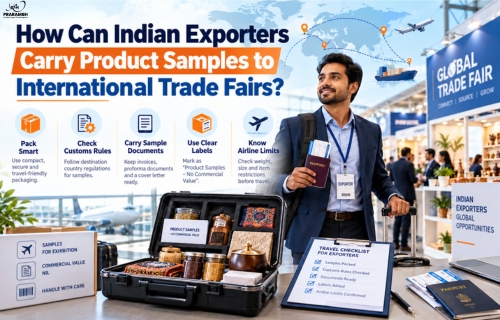
International trade fairs are excellent opportunities for Indian exporters to meet overseas buyers, showcase their products and build business relationships. However, carrying product samples across international borders requires proper planning.
Whether you are carrying spices, textiles, engineering components or handicrafts, you must understand airline baggage rules, customs requirements and the destination country’s import regulations. A well-prepared sample kit can help you make a professional impression and avoid unnecessary delays.
- Check Whether Your Product Can Be Carried
Before packing, check whether your product is permitted in your destination country. Certain products, such as food items, seeds, chemicals, cosmetics and plant-based materials, may require special permits, declarations or certificates.
Example: If you are carrying turmeric powder samples to a food trade fair in Germany, check the applicable EU food import requirements before travelling. Do not assume that a small quantity is automatically exempt from the rules.
- Decide Whether to Carry Samples in Your Baggage or Ship Them
Small, non-restricted samples may be suitable for hand baggage or checked baggage, subject to airline and customs rules. Heavy, bulky, fragile or regulated samples may be better sent through a courier or freight forwarder in advance.
Always check airline restrictions for liquids, powders, sharp components and other restricted items.
Example: An exporter carrying two lightweight fabric swatches to a textile fair in Dubai may be able to pack them in their baggage. However, an exporter carrying large machinery components for a German exhibition may need to arrange advance shipment.
- Prepare the Right Documents
Keep the relevant documents ready to explain what the samples are, their value and why you are carrying them.
Depending on the product and destination, these may include:
- Pro forma invoice: Lists the product description, quantity and declared value.
- Packing list: Details the samples packed.
- Product catalogue: Helps buyers understand your products.
- Supporting certificates or permits: Required for certain regulated products.
- Customs declaration or temporary admission documents: May be required depending on how the samples enter the country and whether they will be returned.
Clearly describe the samples and declare them truthfully. Do not declare a commercial sample as having zero value simply because it is free of charge.
- Understand Temporary Import Rules
If you intend to take samples abroad for display and bring them back to India, check whether a temporary admission procedure or an ATA Carnet is suitable for your destination and goods.
An ATA Carnet can facilitate temporary admission of eligible goods for purposes such as exhibitions and trade fairs, subject to the countries involved and applicable conditions. It is not a universal solution for consumable samples or goods intended to be given away.
Example: An Indian exporter displaying reusable engineering tools at an overseas exhibition may be able to use an ATA Carnet if the goods and destination qualify. However, food samples intended for tasting or distribution may require a different customs procedure.
- Pack Samples Professionally
Your samples represent your business. Use clean, sturdy and suitable packaging to protect them during travel.
- Label each sample with the product name and HS code, where appropriate.
- Include your company name and contact details.
- Carry product specifications, brochures and business cards.
- Protect fragile samples with suitable cushioning.
- Check labelling and packaging requirements for the destination country.
For food, chemical or other regulated products, ensure the packaging and labels meet applicable requirements.
- Declare Samples Honestly at Customs
At departure or arrival, follow the relevant customs declaration procedures. Be prepared to explain the purpose, quantity and value of the samples.
Avoid assuming that samples carried for business purposes are automatically duty-free. Customs authorities may assess duties, taxes or other requirements based on the goods and the applicable procedure.
If you plan to distribute, sell or consume samples at the exhibition, check the rules before travelling.
- Plan Ahead to Avoid Last-Minute Problems
Start preparing at least a few weeks before the fair, especially if your samples need permits, testing, certificates or advance shipment.
Confirm the venue’s delivery instructions, customs arrangements and deadlines. Keep digital and physical copies of important documents.
Quick Example: An Indian Incense Stick Exporter Attending a Trade Fair in France
Suppose an Indian exporter plans to carry 20 incense stick sample packs to a trade fair in France.
Before travelling, the exporter should:
- Check French and EU requirements for the product and its packaging.
- Confirm airline baggage restrictions and any applicable transport rules.
- Prepare a sample list and a pro forma invoice with accurate quantities and values.
- Check customs requirements for bringing the samples into France and distributing them to potential buyers.
- Pack the samples securely and carry product details and business cards.
If the exporter intends to leave the samples with buyers, the customs and tax treatment may differ from that of samples brought temporarily and returned to India.
Examples: How to Carry Different Product Samples to an International Trade Fair
Some Examples:-
| Product | How to carry the sample | Important precautions |
|---|---|---|
| Coconut Oil | Carry a small, tightly sealed bottle in checked baggage or arrange courier shipment, subject to carrier rules. | Check liquid restrictions, leakage-proof packaging, destination-country food import rules and labelling requirements. |
| Fulvic Acid (Powder Form) | Carry a small, securely sealed sample in its original or suitable labelled packaging, only after confirming airline and customs acceptance. Courier shipment may be more appropriate. | Check the Safety Data Sheet (SDS), product classification, chemical transport restrictions and destination-country import requirements. Do not assume a powder is permitted in cabin baggage. |
| Rice | Carry a small, sealed sample pack or send it through an approved courier, depending on destination rules. | Rice may be subject to plant-health, phytosanitary, food import and labelling requirements. Check whether personal carriage or sample import is permitted. |
| Red Chilli Powder | Pack a small quantity in a sealed, clearly labelled food-grade pouch or container, if permitted. | Check food import rules, ingredient declarations, food safety requirements and restrictions on powders in cabin baggage. |
| Stone Handicrafts | Carry small pieces in padded packaging or use a courier for heavy or fragile items. | Check baggage weight limits, breakage risk, stone composition and any restrictions relating to protected materials or cultural artefacts. |
| Important Note:
An ATA Carnet is an international customs document that allows eligible goods to be taken temporarily into another country without paying import duties and taxes at the time of entry, provided the applicable conditions are met and the goods are re-exported within the permitted period. It is often called a “passport for goods” because it simplifies customs procedures when businesses travel internationally with goods for exhibitions, trade fairs, professional equipment or commercial demonstrations. For Indian exporters attending international trade fairs, it can be useful when they want to display products and bring them back to India after the event. |
Conclusion
Carrying product samples to an international trade fair is more than a packing exercise. Indian exporters must plan for airline restrictions, customs declarations, destination-country regulations and the intended use of the samples.
Prepare your documents early, pack professionally and verify the rules for your specific product and destination. These simple steps can help you focus on what matters most at the fair: connecting with buyers and creating export opportunities.
Frequently Asked Questions (FAQs)
- Can I carry product samples in my cabin baggage when travelling internationally?
Yes, some samples can be carried in cabin baggage, subject to airline security rules, baggage limits and the destination country’s regulations. Liquids, powders, sharp objects and restricted products may face additional restrictions.
- Do Indian exporters need to pay customs duty on samples carried to an international trade fair?
Not necessarily. The treatment depends on the product, destination, value, quantity and intended use. Samples may qualify for specific relief or temporary admission procedures, but duty-free entry should never be assumed.
- What documents should I carry for product samples at an international trade fair?
Depending on the shipment, you may need a pro forma invoice, packing list, product details, certificates or permits, and customs or temporary admission documents. Requirements vary by product and country.
- What is an ATA Carnet, and can exporters use it for trade fairs?
An ATA Carnet is an international customs document that can simplify temporary admission of eligible goods for exhibitions and other approved purposes. It generally does not cover goods intended for sale, consumption or distribution, so check whether your samples qualify.
- Can I distribute free product samples to overseas buyers at a trade fair?
Possibly, but free distribution does not automatically exempt samples from customs, tax, food safety, labelling or other import requirements. Check the destination country’s rules before distributing them.
- Is it better to carry samples or courier them before the exhibition?
Carry small, permitted samples when practical. Consider advance courier or freight shipment for bulky, fragile or regulated products, allowing sufficient time for customs clearance.
- How early should I prepare product samples for an international trade fair?
Start several weeks in advance. Allow extra time if your product requires permits, testing, certificates, special packaging or temporary admission arrangements.