

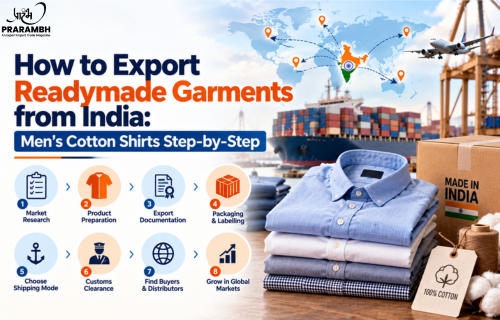
Exporting men’s cotton shirts from India offers an opportunity for manufacturers and merchant exporters to enter the international apparel market. From sourcing quality cotton shirts to finding overseas buyers, completing export documentation and arranging international shipping, every step requires proper planning.
India is an important global textile and apparel sourcing destination, supported by its cotton supply, garment manufacturing clusters, skilled workforce and diverse product range. In FY 2025–26, India’s exports of ready-made garments across textile types reached approximately ₹1,39,350 crore, reflecting growth of 2.9% over the previous financial year.
This step-by-step article explains how to export men’s cotton shirts from India and prepare your first garment export order.
- Choose Your Product Range
Check the HS code for your product. Match the description with the HS Code.
Decide what type of shirts you will export:
- Formal shirts / Dress shirts
- Casual shirts
- Printed shirts
- Denim shirts
- Workwear/uniform shirts
- Premium fashion shirts
Also decide:
- Fabric quality (cotton, poly-cotton, linen, denim, rayon)
- GSM
- Stitching standards
- Packaging style
- Identify Your Target Market (Country)
Some strong importing countries for shirts from India include:
- USA, UK, Germany
- UAE, Saudi Arabia
- Australia
- France, Spain
- South Africa
- Canada
Check the demand, price range, buyer requirements, certifications, and quality norms of the buyer’s country.
- Find International Buyers
You can find shirt buyers through:
➤ B2B platforms
➤ Trade shows
➤ Export Promotion Councils
➤ Direct marketing
- Create Samples
No buyer will place bulk orders without approving:
- Fabric sample
- Stitch quality
- Measurement chart
- Packaging sample
Ensure shrinkage, color fastness, stitching, and fitting meet buyer expectations.
Also, prepare a Quotation to be shared with your prospective buyer.
- Negotiation: Price, Quantity & Terms
Discuss with the buyer:
- Unit price (FOB or CIF)
- Minimum order quantity (MOQs)
- Lead time
- Payment terms
- Packing details
- Shipping method (FCL/LCL/Air)
- Decide Payment Terms
Safer payment terms include:
- Advance Payment (most preferred)
- Letter of Credit (very safe)
- Documents Against Payment (CAD)
- 50% Advance + 50% before shipment (common in garments)
Avoid full credit terms for first-time buyers.
- Manufacturing or Sourcing
You can:
- Manufacture shirts yourself OR
- Source from Tirupur, Surat, Ludhiana, Delhi, Jaipur, Bangalore
Quality check is very important before packing.
- Complete Export Documentation
Mandatory export documents for shirts:
- Commercial Invoice
- Packing List
- Purchase Order / LC
- Export Contract
- HS Code declaration
- Certificate of Origin (from Chamber or AEPC)
- Bill of Lading / Airway Bill
- Shipping Bill (generated by Customs)
- Inspection Certificate (if asked by buyer)
- Export Packing Marking
- Compliance & Certifications
Not always compulsory, but useful in many countries:
- ISO certification
- OEKO-TEX certification for fabric
- BSCI / SEDEX audits for factories in EU markets
- GOTS for organic cotton shirts
Some countries ask for special lab tests such as colour fastness or azo-free dyes.
- Packaging & Labelling
Follow buyer instructions:
- Size tags
- Wash care labels
- Country of Origin: “Made in India”
- Barcodes (if required)
- Polybags, carton boxes, vacuum packing (optional)
- Book Logistics
Choose a reliable:
- Freight Forwarder
- CHA (Customs House Agent)
Send shipment as either:
- FCL / LCL by sea
- Courier / Air cargo for small orders
- Customs Clearance
Your CHA will get the Clearance from the Customs. After clearance, they issue the Let Export Order (LEO).
- Receive Payment
- Claim Export Benefits (Optional)
Conclusion
Readymade garments have travelled from the manufacturer in India to the buyer in another country.
Exporting men’s cotton shirts from India can be a promising business opportunity when the exporter combines reliable sourcing, consistent quality, competitive pricing and effective buyer development. Whether you are a garment manufacturer or a merchant exporter, begin by researching suitable international markets, preparing product samples, confirming buyer specifications and calculating the complete export cost.
Frequently Asked Questions
1.What is the process for exporting men’s cotton shirts from India?
The process includes selecting a product and target market, sourcing or manufacturing shirts, finding overseas buyers, agreeing on specifications and prices, completing applicable registrations and documentation, arranging customs clearance and shipping, and receiving payment.
2. What is the HS code for men’s cotton shirts exported from India?
Men’s or boys’ cotton shirts generally fall under HS heading 6205.20 when they are woven garments. The exact Indian ITC(HS) classification depends on the product’s construction and characteristics. Knitted or crocheted shirts may fall under a different heading, so verify the classification before export.
3. Which countries can Indian exporters target for men’s cotton shirts?
Potential markets to research include the USA, the UK, Germany, France, the UAE, Australia and other countries with demand for cotton apparel. Select your market based on buyer demand, import duties, competition, shipping costs, product standards and applicable trade agreements.
4. What documents are required to export men’s cotton shirts from India?
Common requirements include an IEC, commercial invoice, packing list, shipping bill and applicable transport documents. Depending on the destination and transaction, a certificate of origin, inspection or testing documents, specific labelling information and other certificates may also be required. Confirm the current requirements for your product and destination before dispatch.