
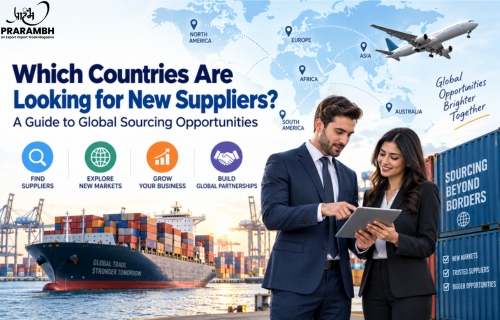
For an exporter, one of the most important questions is: Where can I find buyers for my product?
The answer is not simply to target the biggest countries. A better approach is to identify countries that import your product, have regular demand and offer opportunities for additional suppliers.
Trade databases can help exporters study country-wise import demand, suppliers, tariffs and product-level trade data.
Countries to Explore for Global Sourcing Opportunities
| Country/Market | Sourcing Opportunity Areas* | Suitable Indian Exporters |
| USA | Food products, textiles, engineering goods, healthcare and consumer products | MSMEs and established exporters |
| UAE | Food, spices, textiles, building products and consumer goods | New and experienced exporters |
| Saudi Arabia | Food, consumer products, packaging and industrial products | MSMEs and manufacturers |
| UK | Food, textiles, home products, engineering and wellness products | Certified exporters |
| Germany | Engineering goods, components, chemicals and sustainable products | Quality-focused exporters |
| Netherlands | Food, agricultural products, chemicals and industrial goods | Agriculture and manufacturing exporters |
| Bangladesh | Industrial inputs, machinery, textiles and raw materials | Manufacturers and B2B suppliers |
| Singapore | Food, chemicals, engineering and consumer products | Quality-compliant exporters |
These are broad opportunity areas, not guarantees of buyer demand. Product-level import data should always be checked before entering a market.
Why Are Buyers Looking for New Suppliers?
International buyers may consider additional suppliers for several reasons:
- To diversify their supply chain
- To reduce dependence on one supplier or country
- To find competitive prices
- To access new products or product variations
- To improve delivery options
- To meet changing customer demand
- To find suppliers offering suitable quality or certifications
Changes in transport costs, tariffs, geopolitical conditions, production costs and consumer demand can also influence global sourcing decisions.
What Makes a Country a Potential Sourcing Opportunity?
A market becomes more attractive when several factors come together:
Import Demand + Suitable Price + Manageable Regulations + Reliable Buyers + Competitive Supply = Potential Export Opportunity
Import demand alone does not guarantee profitability. Exporters should also consider:
- Import duties and taxes
- Freight costs
- Product certifications
- Competition
- Payment terms
- Buyer requirements
- Local product standards
A Simple Example
Suppose an Indian exporter sells moringa leaf powder.
Instead of approaching buyers worldwide, the exporter can identify countries importing similar products, study competing suppliers and understand market requirements.
The exporter can then target food processors, ingredient distributors, health-product manufacturers and wholesalers in those markets.
This makes buyer searching more focused than contacting companies randomly.
Conclusion
There is no single list of countries that are always “looking for new suppliers.” Global sourcing opportunities change according to product demand, price, regulations, competition and supply-chain conditions.
For exporters, the better approach is to identify product-specific import demand, study existing suppliers and then search for genuine buyers.
In global trade, the right market is not necessarily the biggest market. It is the market where your product, price, quality and capabilities match buyer demand.
FAQs
- Which countries are good markets for Indian exporters?
The USA, UAE, UK, Germany, Netherlands, Saudi Arabia, Bangladesh and Singapore are among the important markets for Indian exports. However, suitability depends on the specific product.
- How can I find countries that import my product?
Start with your HS code and research country-wise import value, quantity, suppliers, tariffs and trade trends.
- Does high import demand mean there is an opportunity for a new supplier?
Not necessarily. Demand should be considered along with competition, pricing, regulations, logistics and buyer requirements.
- How can a new exporter find buyers in another country?
Identify relevant importers, distributors, manufacturers, wholesalers and processors, and approach them with product specifications, certifications and a clear commercial offer.
- What should I check before entering a new export market?
Check import demand, tariffs, certifications, product standards, labeling requirements, freight costs, competition, payment terms and potential buyers.