
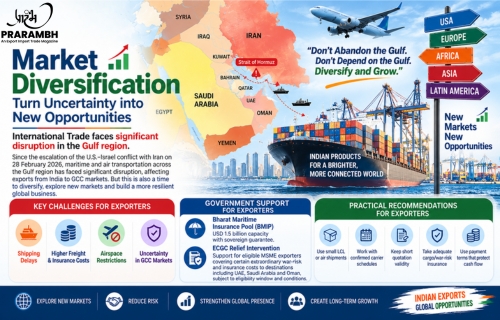
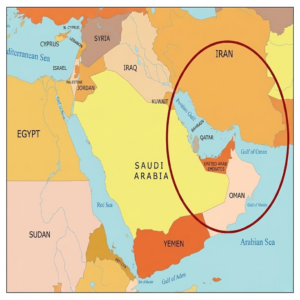
Since the escalation of the U.S.–Israel conflict with Iran on 28 February 2026, maritime and air transportation across the Gulf region has faced significant disruption. Shipping through critical routes, particularly the Strait of Hormuz, has been affected by security concerns, while airspace restrictions and flight suspensions have disrupted air-cargo movement. This has created delays, higher freight and insurance costs, and uncertainty for Indian exporters supplying the GCC markets. Though the disruption varied by country, route, carrier, port and period, it adversely affected exports from India to the GCC or middle eastern countries.
Don’t abandon the Gulf. Don’t depend on the Gulf.
That means, include the Gulf Countries, but add other countries.
Currently we recommend small LCL or air shipments, confirmed carrier schedules, short quotation validity, adequate cargo/war-risk insurance, and payment terms that protect cash flow, rather than committing to large FCL shipments based on old freight rates.
India has also introduced the Bharat Maritime Insurance Pool (BMIP) with a USD 1.5 billion capacity and sovereign guarantee to help maintain maritime insurance availability amid the Middle East tensions.
There was also an ECGC relief intervention covering certain extraordinary war-risk/emergency shipping and insurance costs for eligible MSME exporters to destinations including UAE, Saudi Arabia and Oman, subject to its eligibility window and conditions.
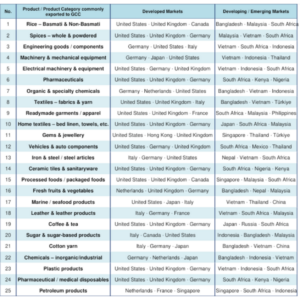
Let us seek opportunity in this crisis and find a detailed understanding of products that can be exported to different destinations, markets, and countries.
I would select alternative markets where India already has a significant export relationship and where the product has established demand. This makes the diversification strategy much more practical.
One important caution
“Alternative market” does not mean “replace UAE/Saudi Arabia with this country immediately.”
For each product, the exporter should next check:
HS Code → country’s import value → India’s export value to that country → import duty → FTA/preferential duty → certifications → product standards → buyer type → freight → payment risk → competition.
For example, rice may have excellent demand in a country but face quotas or specific phytosanitary requirements. Similarly, pharmaceuticals and medical products require substantially more regulatory work than spices or textiles.
Frequently Asked Questions (FAQs)
1. Why should Indian exporters diversify beyond Gulf countries?
Indian exporters should diversify to reduce dependence on a single region, manage geopolitical and logistics risks, reach new buyers, and build more resilient export businesses.
2. What are the best alternative export markets for Indian products?
Depending on the product, potential markets include the United States, United Kingdom, Germany, Canada, Italy, Netherlands, South Africa, Vietnam, Malaysia, Indonesia, Kenya and Nigeria.
3. Which Indian products have strong export potential outside the GCC?
Indian exporters can explore opportunities for rice, spices, engineering goods, machinery, textiles, garments, pharmaceuticals, medical disposables, chemicals, gems and jewelry, processed foods and auto components.
4. How can Gulf trade disruptions affect Indian exporters?
Gulf disruptions can affect shipping schedules, air cargo, freight rates, insurance costs, transit times and payment cycles, particularly for businesses dependent on GCC markets.
5. Should Indian exporters stop exporting to the UAE, Saudi Arabia and other GCC countries?
No. Market diversification does not necessarily mean leaving GCC markets. Exporters can maintain existing Gulf business while gradually developing additional markets across Europe, Asia, Africa and North America.
6. How can Indian exporters choose the right alternative country?
Start with the product’s HS Code, then evaluate the country’s import demand, India’s existing exports, import duties, preferential tariffs, certifications, standards, buyer types, freight costs, competition and payment risks.
7. Which alternative markets can Indian medical and pharmaceutical exporters explore?
Depending on the specific product and regulatory requirements, exporters may evaluate markets such as the United States, United Kingdom, Germany, South Africa, Kenya and Nigeria. Medical and pharmaceutical products generally require detailed regulatory assessment before market entry.
8. How can Indian MSME exporters reduce risk during Middle East trade uncertainty?
Exporters can consider smaller shipments, confirm carrier schedules before dispatch, maintain shorter quotation validity, review cargo and war-risk insurance, protect cash flow through suitable payment terms, and diversify buyers geographically.
9. What is export market diversification?
Export market diversification is a strategy of selling products across multiple countries or regions instead of depending heavily on one destination. It can help businesses spread commercial, geopolitical, logistics and demand risks.
10. What should exporters check before entering a new international market?
Before entering a new country, check HS classification, market demand, India’s export performance, customs duty, FTA benefits, product regulations, certifications, labeling requirements, buyer profile, freight, payment security and competition.